3 truths on the fables about ‘dolphin-safe’ labels

It all started recently as my 2 year-old showed those tendencies towards becoming a picky eater. I embarked on a supermarket safari for proteins and soon enough I found myself in the canned tuna aisle. Have you been there lately? It’s a little overwhelming with all of the labels. I usually just go for the salmon for the additional omega-3s, but I had a feeling the toddler would turn that down. Also, I am all about rites of passage and isn’t canned tuna with mayonnaise on toast right up there with peanut butter and jelly and macaroni and cheese? Given that I do care, especially with the recent findings of an Oceana report that states 1 in 3 fish are mislabeled,  the nerd in me had to navigate the meaning behind all those ‘eco-safe’ labels found on canned tuna.

Here’s some surprising truths behind the fables about the ‘dolphin-safe’ label you’ll need to know before baking your next casserole:

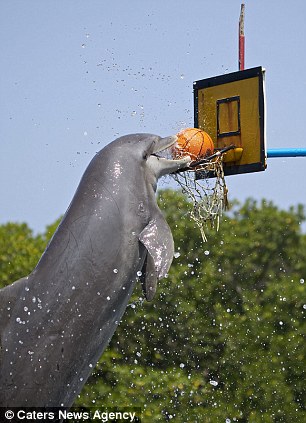
1) The U.S. wouldn’t sell anything that’s not ‘dolphin-safe’ – label or not. While it’s true that the U.S. has the most restrictive definition of what it means to be ‘dolphin-safe’ it’s also true that canned tuna is the #1 seafood import in the U.S. The internationally accepted definition of ‘dolphin-safe’ is “tuna caught in sets in which dolphins are not killed or seriously injured,” but the U.S. requires that “no tuna were caught on the trip in which such tuna were harvested using a purse seine net intentionally deployed on or to encircle dolphins, and that no dolphins were killed or seriously injured in the sets in which the tuna were caught.” Unfortunately, if we’re rarely eating tuna from the U.S. we can’t say how it’s caught.

2) ‘Dolphin-safe’ labels are designated by the government. I was shocked to realize that its independent observers (i.e., private organizations) making claims to what is ‘dolphin-safe’. But, then I remembered that tuna are an especially difficult species to manage given that they migrate all over the world. The good news on the horizon is that during his State of the Union address in January, President Obama mentioned the U.S. will begin negotiating a free trade agreement (FTA) with the European Union. What does this have to do with tuna fisheries? Well, apparently the talks for the FTA would include discussions on non-tariff barriers. Non-tariff barriers include “things like labels indicating a product’s country-of-origin, whether tuna is dolphin-safe, or whether your breakfast cereal has genetically-modified corn in it.” The need to be more consistent as to how we label tuna was also acknowledged by the World Trade Organization (WTO). The WTO noted that, “while well-intentioned, the ‘dolphin-safe’ labels are deceptive to consumers and quite outdated”. Also, according to the Campaign for Eco-Safe Tuna, “There’s no denying that more than 98% of the tuna in the U.S. market today is sourced from unmonitored and untracked fisheries where thousands of dolphins are killed every year.” That’s a frightening statistic if you’re trying to make the right choice on what can of tuna to purchase.

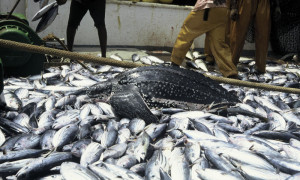
leatherback_worldwildlifedotorg

Image (c) World Wildlife Fund

3) If it’s ‘dolphin-safe’ it must be safe for all marine life. Let’s cut to the chase here. Canned tuna that is troll or hook-and-line caught is the best choice for a conscious consumer. Other methods of fishing for tuna (e.g., backdown technique, purse seines) have been shown to cause long-term stress to dolphins (leading to their eventual death), including heart and muscle lesions. You might also be disheartened to realize that sharks, billfish, birds, and sea turtles (see image) are often the unintended catch (known as ‘bycatch’) of fishing for tuna. The fish aggregating devices (FAD) commonly used to catch tuna are known as some as the most destructive fishing practices man has ever used.

Where does that leave me in the decision of what type of tuna to purchase for my family? As I mentioned, choosing hook and line (also known as ‘pole-caught’) canned tuna is the most sustainable choice. Fishing for tuna with hook and line 1) enables fish that are too small to be returned to the ocean, 2) practically eradicates any bycatch, and 3) ensures the ocean ecosystem to remain intact eliminating the potential loss of biodiversity. Be careful though since ‘line-caught’ can mean using a longline to catch tuna. However, this method produces ample bycatch as well.

Please feel free to comment below or email questions on this article to Ann McElhatton, Beach Chair Scientist, at info@beachchairscientist.com.

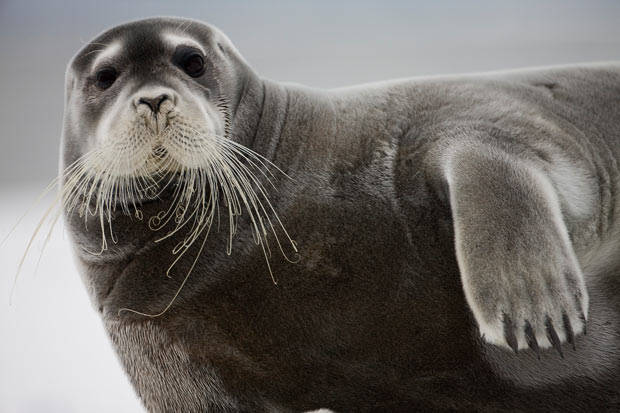
Ho, ho, ho! Look who’s coming to town … it’s the bearded seal!

The rather short snout with thick, long, white whiskers gives this true seal it’s appropriate common name. The bearded seal (Erignathus barbatus) can be as long 8 feet and weigh up to 800 pounds. I guess now we know what idiom they use under the sea instead of “the 800 pound gorilla in the room …”. These seals tend not to be seen in packs like their more social counterparts we view along harbors.

Bearded seals spend most of their lives in the Arctic waters, although one was recently found in southeast Florida. They enjoy feasting on arctic cod, shrimp, clams, crabs, and octopus and have been known to live up to 25 years. For more information on the conservation efforts and status of the bearded seal population please check out this page created by the NOAA Fisheries Service Office of Protected Resources.

Adult bearded seal by by wildlife photographer Paul Souders

Adult bearded seal by wildlife photographer Paul Souders

Image (c)  www.telegraph.co.uk

If you gooble, gooble the turkeyfish know your source

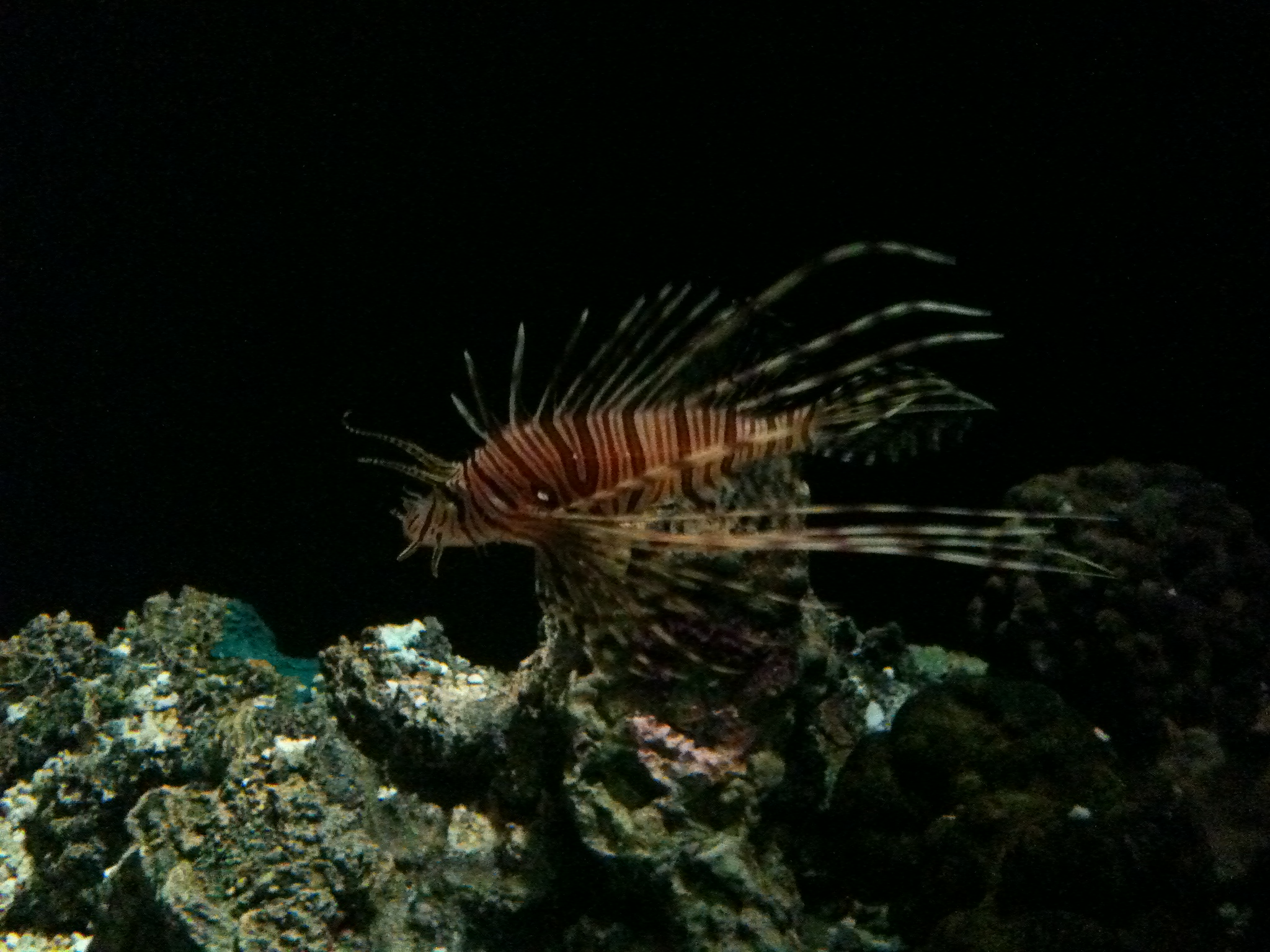
The extravagant fins of the lionfish, native to the the Indo-Pacific, resemble the plumage of turkeys and have thus earned the additional common name of ‘turkeyfish’. What is so ironic about that particular nickname is that scientists and fisheries managers have urged us to ‘gooble’ up this exotic looking creature. What’s happened over time is a gradual introduction of the lionfish along the southeast coast of the U.S., the Caribbean, and in parts of the Gulf of Mexico by way of too many releases from fish tanks in the late 1980′s and early 1990s. Unfortunately, these fish have become quite a nuisance in their new neighborhood. In 2010, Juliet Eilperin wrote this on how the lionfish are destroying the reefs along the southeastern Atlantic coast, “As a top predator, it consumes juvenile snapper and grouper along with algae-eating parrotfish, all of which help keep reefs healthy. Between 2004 and 2008, local densities of lionfish increased by roughly 700 percent in some areas; there are now 1,000 lionfish per acre on certain reefs”. As part of the plan for recovering the reefs, in 2010 a campaign was launched to catch lionfish and deep fry, blacken, sautée, or even turn it into an ingredient in sushi. Although, it is imperative that your know you’re source. This past summer, the FDA tested almost 200 lionfish and found there was a high level of the toxin that causes ciguatera in nearly a quarter of the fish. However, according to Michael Dimin, founder of Sea to Table, sautéeing them is still the best way to regain a more natural balance.

Not interested in eating them? You can even help to control the population by becoming a lionfish hunter yourself!

Are manatees and elephants related?

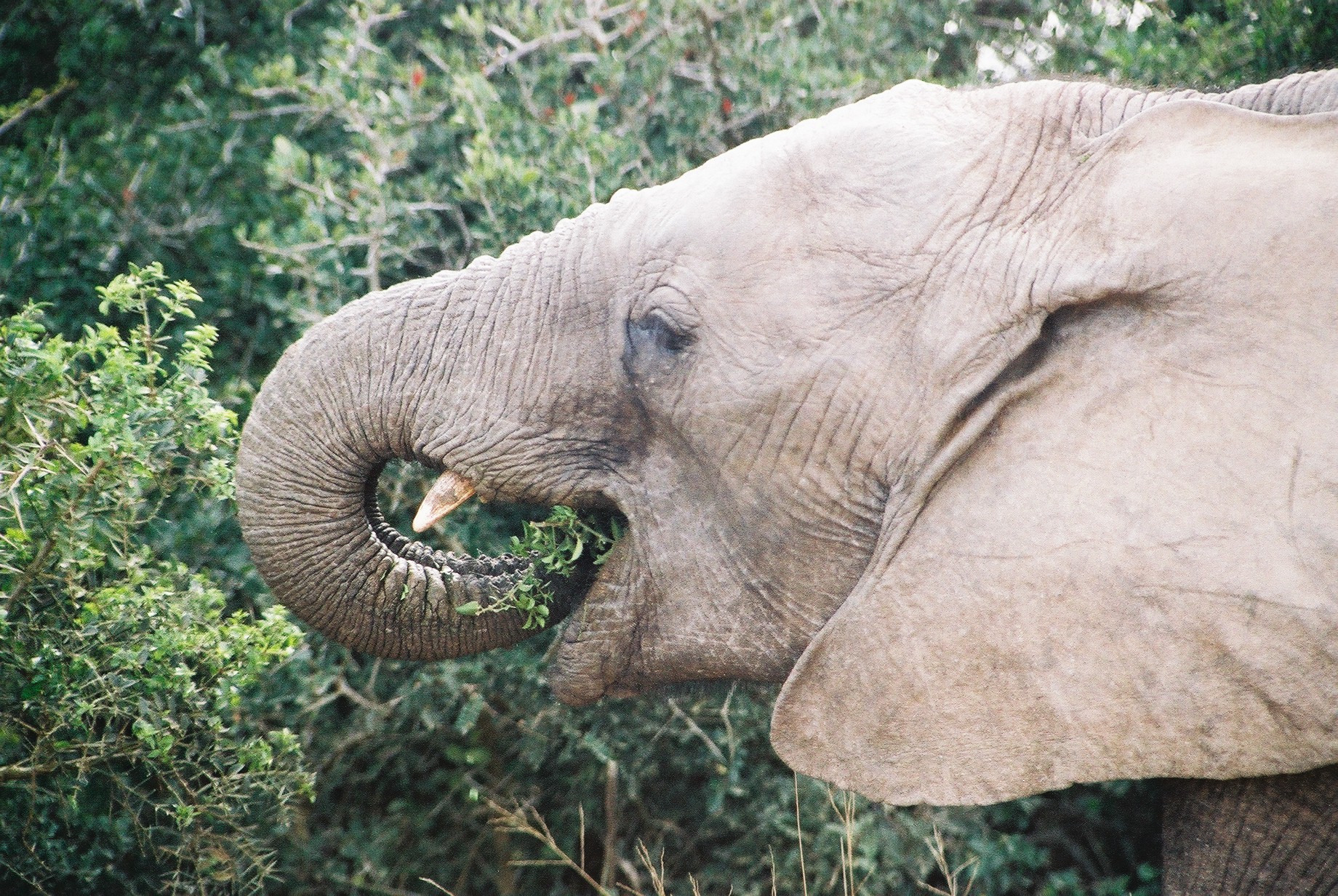
It might be very difficult to imagine, but manatees (also known as ‘sea cows’) share a common ancestor with elephants which might come as a surprise if you thought manatees shared a common ancestor with other marine mammals such as dolphins, whales, or sea lions. Here are 10 facts that link manatees and elephants are long-lost relatives.

1. Scientifically, manatees and elephants are classified as subungulates. Other mammals in the Subungulata superorder are hyraxes and aardvarks.
2.Manatees and elephants have an uncommon-shaped heart that is spherical. To compare, most mammals have a single-pointed tip at the base (i.e., “heart”—shaped).
3. The West Indian and West African manatee have three or four fingernail-like structures on the tip of their flippers, just like that of the toenails on the feet of elephants.
4. Manatees and elephants both have a thick, gray skin with very sparse hair.
5. Manatees and elephants have molars which move toward the front of the mouth, eventually break off, and are restored by those at the rear. Elephants have a limited number while manatees are never-ending.
6. Manatees have two incisors that bear a resemblance to elephant tusks.
7. Manatees use their large, flexible muscular lips to break apart vegetation in the water and skillfully steer food to their mouths. This is very similar to the action of the elephant eating with his trunk.
8. Manatees and elephants are herbivores. Manatees tend to feast on sea grass and freshwater plants and consume up to 100-150 pounds a day. Elephants tend to feast on small plants, bushes, fruit, twigs, tree bark, and roots and consume up to 330-375 pounds a day.
9. Male manatees and elephants are known as bulls. Female manatee and elephants are known as cows. Young manatee and elephants are known as calves.
10. Manatees and elephants are both endangered. Their numbers have dropped due in a large part to human activities.

Manatee image (c) cruisenaplesflorida.com, elephant image (c) gallery.hd.org

Here is a fantastic teaching resource from the University of Florida Sea Grant extension I uncovered while pulling this post together.

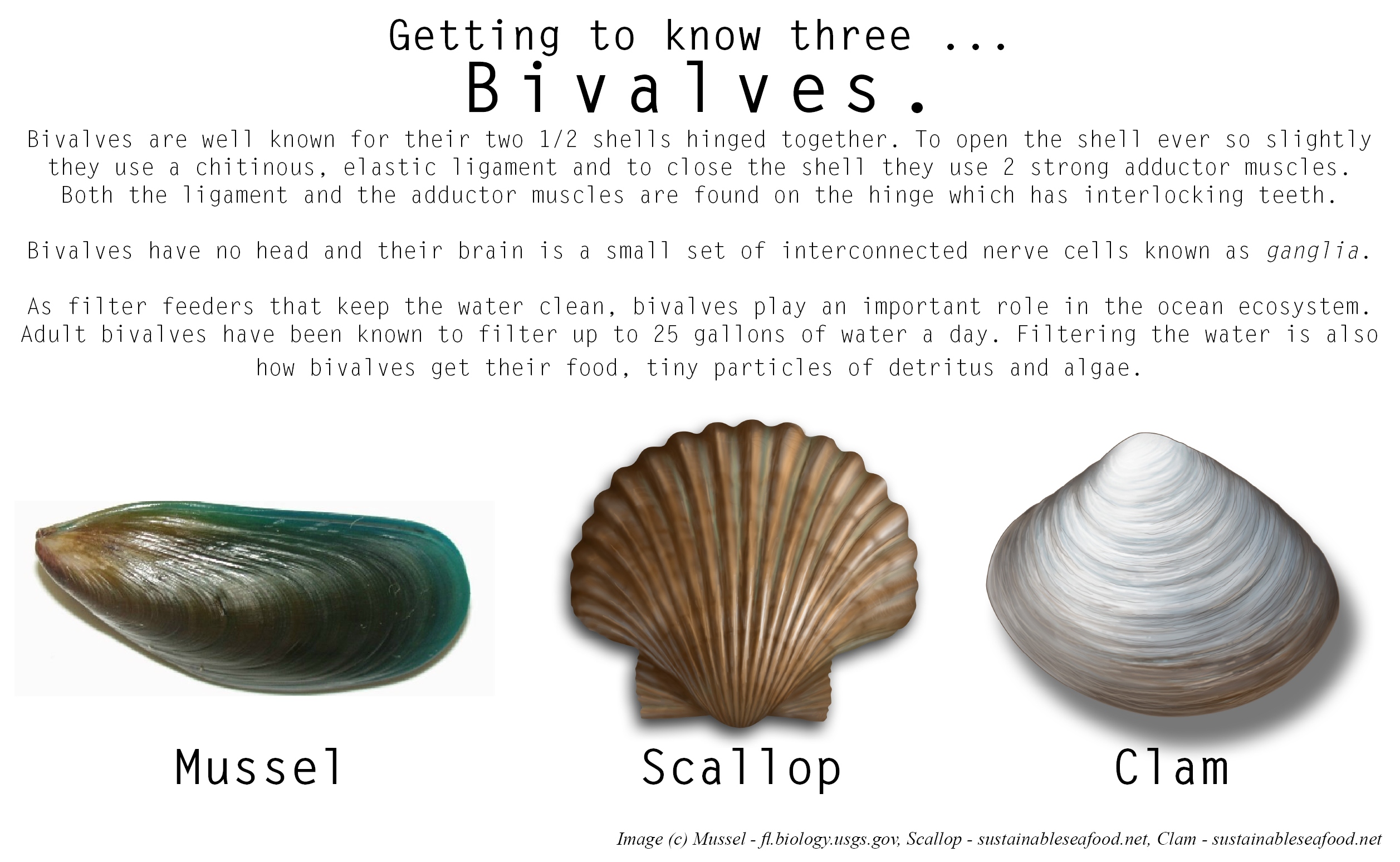
Getting to know three … Bivalve edition

Ever know instinctively that some animals are ‘related’ and just can’t pinpoint their similarities? On the third day of every month I explain three features that are common among three animals of a certain group. Of course, generally each group has more than three representatives and even  many more similarities and then even more differences, but I am going to choose three similarities that link threes to keep it simplified. This month is focused the mussel, scallop, and clam. These three animals are all part of the bivalve group which is the second largest group of mollusks. The largest group of mollusks are the gastropods. Mollusks are well-known for their soft, unsegmented bodies and shell covering (although cephalopods do not have this feature). Check out the image below to learn what the featured animals all have in common.


10 tips for a successful beachcombing trip

It’s my favorite time of year. This is the best time to explore the beach. It’s still sunny and warm, there are frequent storms (you’ll see why that matters later), and there are few people on the beach. For another six weeks along the mid-Atlantic (before it gets too cold), I encourage you to spend some time getting to know your local shoreline. Here are 10 tips for a successful beachcombing trip.

10. What to bring. Here is a list of some items you may want to remember so you’re prepared for any situation.

  • Often the beach is considerably cooler than inland so bring layers. You may want to wear hiking pants and bring a zippered sweatshirt so you’re equipped with lots of pockets for some other items that might be essential.
  • Make sure to have some appropriate soles. Sure it’s our instinct to be barefoot, however if you want to venture out along the jetties or rocks make sure you have some old sneakers or those water shoes with some decent grip (After all, you don’t want to ruin your adventure with a puncture to some sharp object). Also, the water might be a little cooler than you’d prefer and some good foot cover will allow you to wade into a tide pool.
  • Make sure to have a watch.
  • Even during the off-season the sun is shining and is strong enough to give you a burn. Make sure to bring along a hat, sunglasses, and sunscreen.
  • It’s always a good idea to bring a shovel, grabber sick, or even a metal detector so you can gently investigate inside crevices and below the sand.
  • You are going to want to cherish the moments so find that camera and try to make a neck strap so it’s always handy. You can take pictures of items you find and want to learn about later. You’ll also want to catalog those smiles in the sun.
  • Take along a small (i.e., not heavy) identification book so you can learn more about what you find while on your outing.

9. Be hands free. One more item that you’re going to love me for suggesting is a backpack. This way you can investigate a little bit further from your base and your items are quickly at your disposal.

8. Leave important items behind. Don’t ruin the day by losing a credit card or your phone. If you’re active and in the moment you might lose something and it’s going to be difficult to retrace your steps. I won’t say “I told you so”. On the same note it’s important to leave animals, plants, rocks, and seashells where you find them. If you want to have a little bit of the beach in your home check out these great books by Josie Iselin.

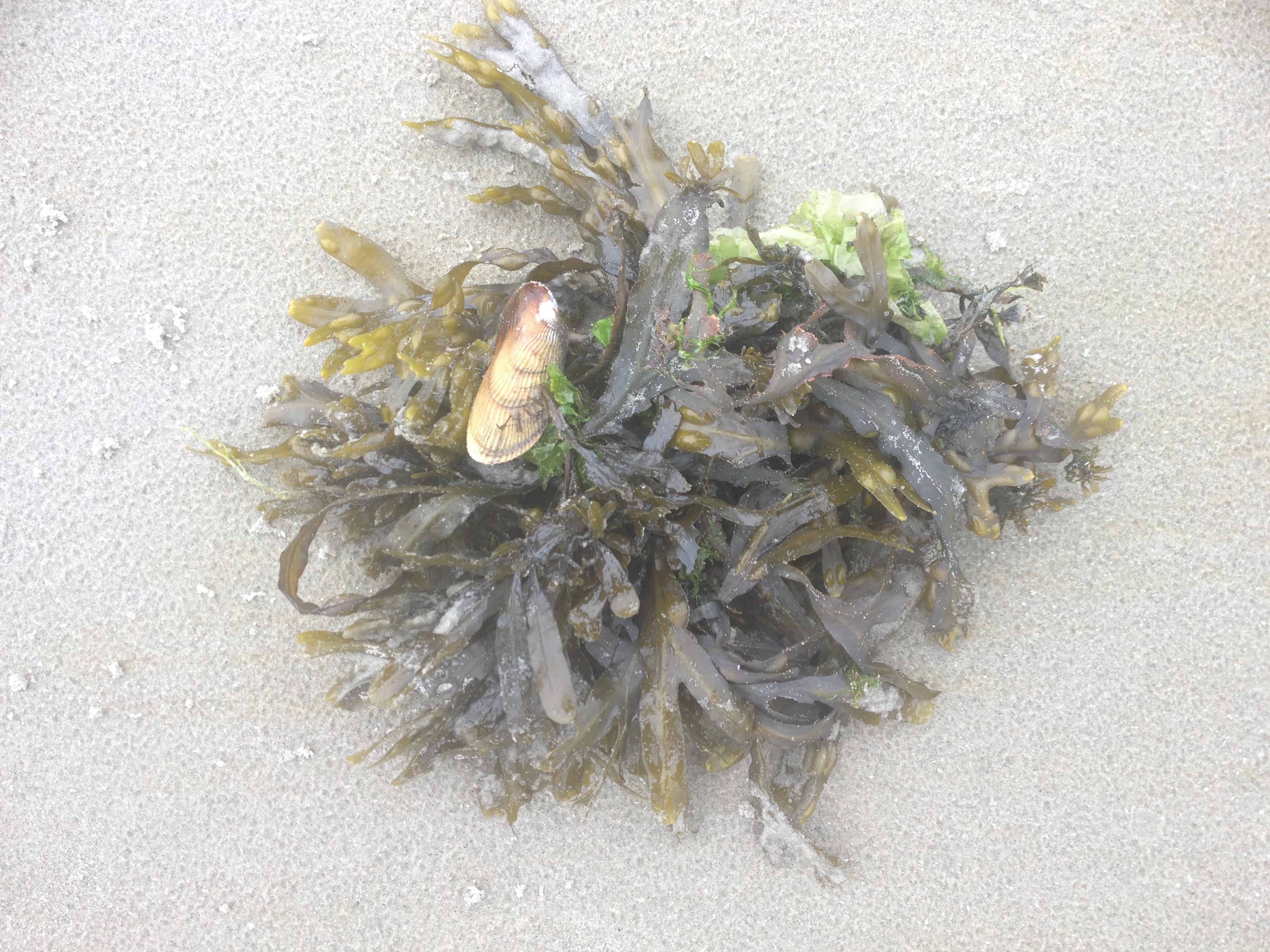
7. When to go. To get the optimum experience for beachcombing you’ll want to check on when low tide is at your beach spot. The best time to go beachcombing is 2-3 hours prior to low tide or an hour or so after (This is why a watch is important, you don’t want to get stuck on  shoal during high tide). Many intertidal animals live under the water in the sand during high tide, but come out to play (and seek out food) during low tide. If you can time it so you get to check out the beach after a big storm you’ll be in for a real treat. The strong wind and wave action of storms will wash up a fossils, bones, seaweed, and lot of other interesting treasures from the ocean floor. Also, keep in mind that dawn and dusk are difficult times to identify beach treasures. Although this is a great time to spot birds as many fish tend to come up to the surface at these times.

6. Where to go. My favorite spot to beachcomb is the Stone Harbor Point in NJ, but it’s not always easy for me to get there these days. I like to remind myself from time to time that I don’t need an ocean to beachcomb. There is a lake and creek in my neighborhood and these spots are a great place to spend the afternoon. After all, these waterways eventually lead to the ocean.  No matter where I decide to spend some time beachcombing I always make sure to note the general water quality.

5. Be careful. This is just a reminder to not tamper with obviously dangerous items. Fish hooks, metal canisters, and needles often wash up on the beach. While I am going to also suggest doing your part and picking up marine debris it’s also a good idea to err on the side of caution and when poking around. Also, some rocks look very steady but it’s important to be aware of your surroundings. If you are feeling like having an adventurous day it’s might be a good idea to make sure you have someone else with you. One last thing about being careful,even though the dunes might look like an interesting place to check out – it’s important to know that those grasses are incredibly brittle and can crack easily. It’s also against the law to walk on the dunes. The dunes are an important part of the beach ecosystem as they protect our homes from storm surge.

4. Leave it be. Each rock that you turn over is part of an ecosystem. A rock might be an essential part of an animal’s home as it helps pool water during high tide. Rocks also protect them from predator as well as the sun. It’s important to always remember to not take animals out of their natural setting – especially if you see them in a tide pool. Many animals are naturally attached to rocks for survival and you could be risking their survival.

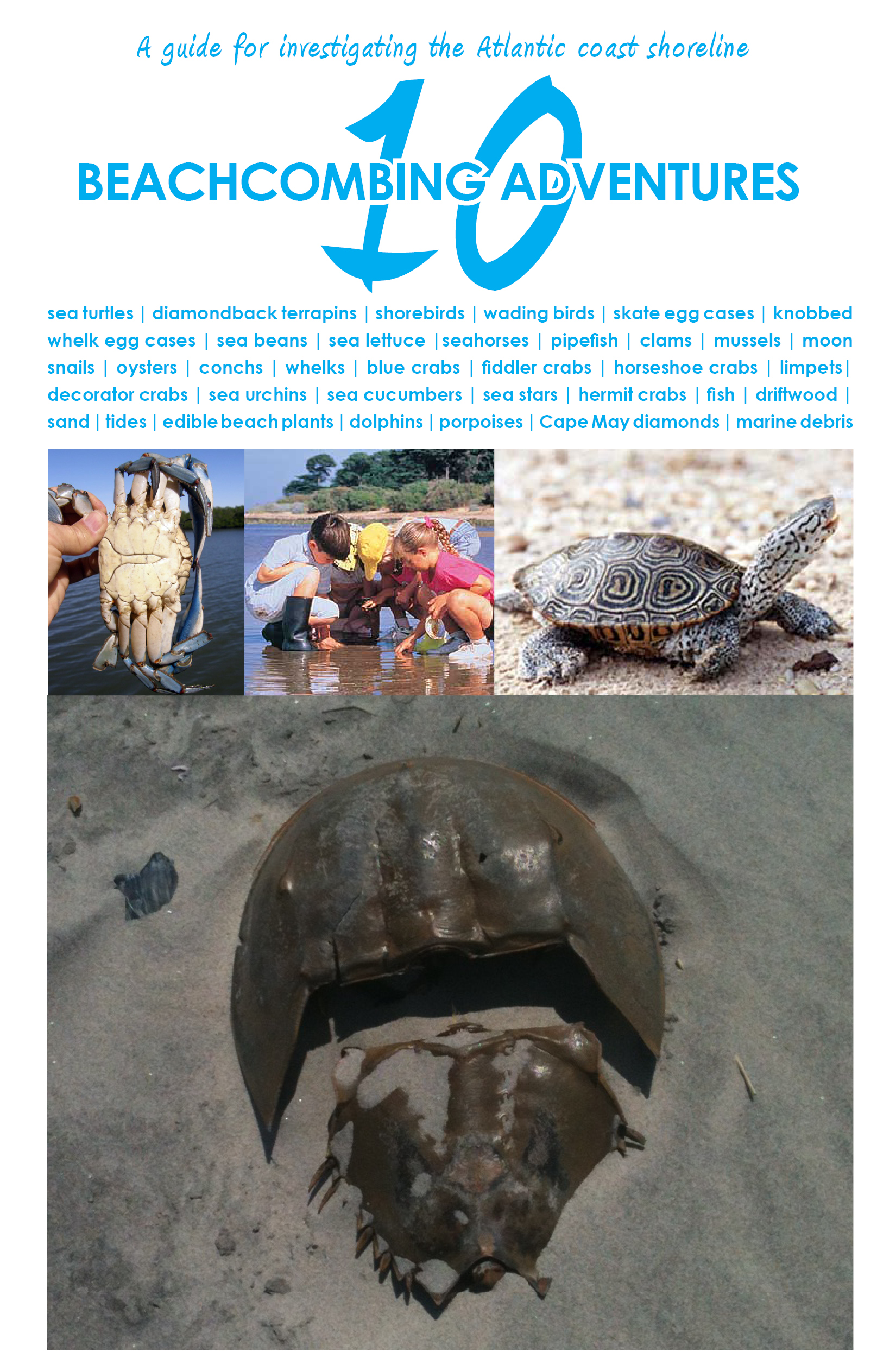
3. Play. You might not want to go home, but you also might be in the company of some people that just don’t have a very long attention span. Even more frustrating is repeating the phrase, “No, you cannot go in the water today” over and over again. Build a sandcastle. Look to the horizon for dolphins or porpoises. Make a sand angel. Look up to the sky for cloud animals. Check out my ebook for other beachcombing adventures.

Image (c) Marine Debris Tracker

2. Bag it and track it. It’s always nice to be prepared to be able to do your part. I prefer to take along a hefty canvas bag that can fit in a backpack so I can tote marine debris back to a garbage can. You might even try to acquire one of these nifty bags with holes for sand to percolate through from the Green Bag Lady. When you head back to the car you can even do some citizen science and log your marine debris on the Marine Debris Tracker.

1. Don’t expect too much. It’s important to remember to relax and respect the area you are exploring. All of the ideas above are simply suggestions and ideas to ensure you get the most out of  a beachcombing adventure. Please don’t hesitate to share your favorite stories, spots, and other ideas for a great day. You can comment below of email me at info@beachchairscientist.com.

What they’re into … with Wallace J. Nichols

It’s Tuesday and you know what that means by now if you’ve been following BCS this summer. Time for another installment of “What Marine Conservationists Are Into …”! This is a series I featured in the summer of 2012 to get a special sneak peek at the many different personalities behind the scientists, activists, and educators (including bloggers) who play an integral role in the marine science conservation field. It’s essentially an extension of the overwhelmingly popular and well done Tumblr blog, This Is What A Scientist Looks Like, (BCS was featured in April of 2012!) which sets out to illustrate that scientists are not just crazy haired nerds in lab coats. I sent a list of 15 random questions and asked that each person share at least their answers to 5 of them. For the tenth edition, I am delighted to introduce California conservationist extraordinaire, Dr. Wallace ‘J” Nichols.

Dr. Wallace “J.” Nichols is a scientist, activist, community organizer, author, and dad. He works to inspire a deeper, more active, connection with nature, sometimes simply by walking and talking, other times through writing or images. Science and knowledge can also stoke our fires. But he knows that what really moves people is feeling part of and touching something bigger than ourselves.

J. is a Research Associate at California Academy of Sciences and founder of several conservation initiatives including Ocean Revolution, an international network of young ocean advocates, SEE the WILD, an international conservation travel portal and LiVBLUE, a campaign to reconnect people with our water planet. He earned his Bachelors in Biology and Spanish from DePauw University, an MEM in Environmental Policy and Economics from Duke University’s Nicholas School, and his PhD in Wildlife Ecology and Evolutionary Biology from University of Arizona.

He advises a motivated group of international graduate students and serves as an advisor to numerous non-profit boards and committees as part of his commitment to building a stronger, more progressive, and connected environmental community.

Lately he is working on BlueMarbles.org and BLUEMiND: The Mind + Ocean Initiative. He blogs at wallacejnichols.org and lives on California’s SLOWCOAST.

What is the last thing you bought that you shouldn’t have?
I’ve been off coffee for almost a month. But I bought a “dirty chai tea” which has a shot of espresso hidden down in the glass of tea.

What is your favorite fruit flavor?
Organic local you-pick olallieberry, the season is so short and sweet. Always worth the wait.

What is your favorite Sunday breakfast?
Poached eggs from our chickens, fresh pesto, on sourdough bread. And a dirty chai ; )

What’s your favorite midnight snack?
Ice cream w/ olallieberries!

Are you a night owl or a morning person?
A massive night owl who loves early mornings.

What is your favorite room in your home?
My daughters’ room, because we read stories at night and snuggle. It’s the best part of the day and the house.

Which sitcom character do you relate to?
None. I put some thought into this. And, well, none. That probably explains why we don’t have a TV. Or vice versa.

What is your favorite scent?
So, so many. Can I say olallieberry again? Just kidding. Late on a cool night in the redwoods. Just after a rain in the Sonoran Desert. Any kind of pie.

What is your favorite sundae topping?
Guess.

What is your favorite pastime?
Anything with our kids. They really make anything we do so much fun.

What three things would you take with you to an island?
Shakepeare’s Complete Works. A good machete. Olallieberry seeds.

How superstitious are you?
Not a bit.

What is your favorite day of the week?
Thursday, or Thor’s Day. Named after the Norse god of thunder, lightning storms and oak trees. That’s just cool. I think about that every Thursday.

Are you a cat person, dog person, or neither?
Both. Their names are Fisher (Newfoundland), Jack Wilder (Cairn terrier), Penelope (Maine Coon) and Trout (strange but cute black cat)

If you were a geometric shape, what would you like to be?
I rather like the rhombus. I wouldn’t really want to be one, though.

What’s some other random favorite information about you?
My fascination with neuroscience began in college, when I was 19. I gave weekly guitar lessons to a woman who had lost her memory in an accident as therapy for restoring her memories, and it worked. I’ve been interested in the wonders of the human brain ever since.

Almost ten years ago my partner Dana and daughter Grayce (who was just 1 y.o., her sister Julia wasn’t born yet) walked 1,800 km from Oregon to Mexico along the coast. I highly recommend that everyone take a very long walk (months) through a place that is important to them. It’s a deeply human and transformative thing to do.

Image (c) Jeff Lipsky

What they’re into … with Brittany Biber (Sea turtle trainer)

I am sure you know by now, but this is a series I have been featuring each Tuesday this summer to get a special sneak peek at the different personalities behind the scientists, activists, and educators (including bloggers) who play an integral role in the marine science conservation field. It’s essentially an extension of the overwhelmingly popular and well done Tumblr blog, This Is What A Scientist Looks Like, (BCS was featured in April!) which sets out to illustrate that scientists are not just crazy haired nerds in lab coats. I’ve sent a list of 15 random questions to some folks I know and asked that each person share at least their answers to 5 of them. Here you get a glimpse into what one of my old co-workers who is lucky enough to interact with sea turtles everyday is into, introducing Brittany Hascup Biber.

Brittany works at Florida Oceanographic Society’s Coastal Center on Hutchinson Island in the Aquarium and Life Support Department. Her responsibilities include food preparation, quarantine treatments, and medication dispersal for all the marine life property. The animals on site range from estuarine species such as snook and red drum to sharks, rays, and smaller reef species. In addition to the gilled animals, she also cares for three non-releasable sea turtles, two green sea turtles (Chelonia mydas) and one loggerhead (Caretta caretta). All of the sea turtles on site have been deemed non-releasable due to buoyancy issues. Lily, the 140lb loggerhead, was struck by a boat and has deep scars on her carapace that serve as a good reminder to why obeying boating rules and regulations is so important. Turt, the 90lb green turtle pictured right, has a spastic intestine and must be administered medication every other day to allow him to swim through the water column with ease. Hank the smallest is still a juvenile and weighs around 50lbs. He has carapace deformities that probably led to his floatation problems. Because these turtles will never be released back into the wild they must get accustomed to interactions with their caretakers so that they are calm and receptive when they need to be fed, weighed, or cleaned. She have been in charge of the training and care of the turtles on site since they each arrived here. Each turtle has its own colored “target” that they have been trained to respond to. When the target is placed in the water the corresponding turtle swims over and receives its food and medicine if needed. The training is done every day for all the turtles and it allows her to have daily interactions and alone time with each turtle away from the other animals housed in the 750,000 gallon lagoon they call home. Training the turtles is always the best part of her day, and she says she may be tooting her own horn but she think it is the turtles’ favorite time of day as well (probably since she’s feeding them). When she graduated from college she hoped to work in the animal husbandry field and she is proud to be doing just that. So even though most days she smell like fish and squid she get a chance to interact with species most people rarely get to see and she says she learns something new about them everyday and it makes all the stinky stuff worth it. Brittany has a B.S. in Environmental Studies from the University of Central Florida. You can reach Brittany at bbiber@floridaocean.org.

What is the last thing you bought that you shouldn’t have?
An overpriced bikini.

 What is your favorite fruit flavor?
It’s a tie between watermelon and pineapple.

Are you a night owl or a morning person?
Night owl, I love sleeping and my bed always seems super comfy when I have to get up for work.

What is your favorite room in your home?
My back porch that overlooks the river, I love watching the wading birds like the Eastern oystercatcher and great blue heron feed on the shore. 

What is your favorite scent?
Coconut, because it makes you smell like you’ve been at the beach all day.

What is your favorite pastime?
Going on the boat with my husband; it’s nice just being with each other away from the responsibilities that wait for us on land.

Thank you for participating, Brittany! It was a honor to read about your interesting day at work.

Don’t forget to read the rest of the “What they’re into …” series.

100 ocean quotes

Because there is not just one quote that summarizes how ethereal and majestic the ocean is, and in honor of World Oceans Day, and because you know I like lists, here is an archive of some inspiring quotes about the important aspects of our ocean all from people you may have heard of a time or two. If you have another favorite, please don’t forget to share and comment below.

100 Quotes about the ocean from the Beach Chair Scientist

1. “Man cannot discover new oceans unless he has the courage to lose sight of the shore.” – Andre Gide
2. “In one drop of water are found all the secrets of all the oceans” – Kahlil Gibran
3. “We know that when we protect our oceans we’re protecting our future.” – Bill Clinton
4. “It isn’t the oceans which cut us off from the world — it’s the American way of looking at things.” – Henry Miller
5. “The sea! the sea! the open sea!, The blue, the fresh, the ever free!” – Bryan W. Procter
6. “To me the sea is a continual miracle; The fishes that swim–the rocks–the motion of the waves–the ships, with men in them, What stranger miracles are there?” – Walt Whitman
7. “There is the life of the plankton in almost endless variety; there are the many kinds of fish, both surface and bottom living; there are the hosts of different invertebrate creatures on the sea-floor; and there are those almost grotesque forms of pelagic life in the oceans depths. Then there are the squids and cuttlefish, and the porpoises, dolphins and great whales.” – Sir Alister Hardy
8. “Every time we walk along a beach some ancient urge disturbs us so that we find ourselves shedding shoes and garments or scavenging among seaweed and whitened timbers like the homesick refugees of a long war.” – Loren Eiseley
9. “For whatever we lose (like a you or a me), It’s always our self we find in the sea.” – e.e. Cummings
10. “We are tied to the ocean. And when we go back to the sea, whether it is to sail or to watch – we are going back from whence we came…” – John F. Kennedy
11. “I seem to have been only like a boy playing on the seashore, and diverting myself in now and then finding a smoother pebble or a prettier shell than ordinary, whilst the great ocean of truth lay all undiscovered before me.” – Isaac Newton
12. “Life is life’s greatest gift. Guard the life of another creature as you would your own because it is your own. On life’s scale of values, the smallest is no less precious to the creature who owns it than the largest.” – Lloyd Biggle Jr.
13. “It is a curious situation that the sea, from which life first arose, should now be threatened by the activities of one form of that life. But the sea, though changed in a sinister way, will continue to exist: the threat is rather to life itself.” – Rachel Carson
14. “We ourselves feel that what we are doing is just a drop in the ocean. But the ocean would be less because of that missing drop.” – Mother Teresa
15. “To me, the sea is like a person–like a child that I’ve known a long time. It sounds crazy, I know, but when I swim in the sea I talk to it. I never feel alone when I’m out there.” – Gertrude Ederle
16. “My soul is full of longing for the secrets of the sea, and the heart of the great ocean sends a thrilling pulse through me.” – Henry Wadsworth Longfellow
17. “The sea will grant each man new hope, and sleep will bring dreams of home.” Christopher Columbus
18. “Animal protection is education to the humanity.” – Albert Schweitzer
19. “The least movement is of importance to all nature. The entire ocean is affected by a pebble.” -Blaise Pascal
20. “You can’t do anything about the length of your life, but you can do something about its width and depth.” – Evan Esar
21. “Our knowledge is a little island in a great ocean of nonknowledge.” – Isaac Bashevis Singer
22. “The greatest use of life is to spend it for something that will outlast it.” – William James
23. “The ocean stirs the heart, inspires the imagination and brings eternal joy to the soul.” – Wyland
24. “The tradition of freedom of the high seas has its roots in an era when there were too few people to seriously violate the oceans — but in hindsight that era ended some 150 years ago.” – James Carlton
25. “The true peace of God begins at any spot a thousand miles from the nearest land.” – Joseph Conrad
26. “Why do we love the sea? It is because it has some potent power to make us think things we like to think.” – Robert Henri
27. “The sea hath no king but God alone.” – Dante Gabriel Rossetti
28. “We never know the worth of water till the well is dry.” – Thomas Fuller
29. “After a visit to the beach, it’s hard to believe that we live in a material world.” – Pam Shaw
30. “Primeval forests! virgin sod! That Saxon has not ravish’d yet, Lo! peak on peak in stairways set— In stepping stairs that reach to God! Here we are free as sea or wind, For here are set Time’s snowy tents
In everlasting battlements Against the march of Saxon mind.” – Joaquin Miller
31. “The oceans deserve our respect and care, but you have to know something before you can care about it.” – Sylvia Earle
32. “The sea, once it casts its spell, holds one in its net of wonder forever.” – Jacques Yves Cousteau
33. “A lot of people attack the sea, I make love to it.” – Jacques Yves Cousteau
34. “From birth, man carries the weight of gravity on his shoulders. He is bolted to earth. But man has only to sink beneath the surface and he is free.” – Jacques Yves Cousteau
35. “No aquarium, no tank in a marine land, however spacious it may be, can begin to duplicate the conditions of the sea. And no dolphin who inhabits one of those aquariums or one of those marine lands can be considered normal.” – Jacques Yves Cousteau
36. “Water and air, the two essential fluids on which all life depends, have become global garbage cans.” – Jacques Yves Cousteau
37. “The sea is emotion incarnate. It loves, hates, and weeps. It defies all attempts to capture it with words and rejects all shackles. No matter what you say about it, there is always that which you can’t.” -Christopher Paolini
38. “Because there’s nothing more beautiful than the way the ocean refuses to stop kissing the shoreline, no matter how many times it’s sent away.” -Sarah Kay
39. “Hark, now hear the sailors cry / smell the sea, and feel the sky / let your soul & spirit fly, into the mystic.” -Van Morrison
40. “Total physical and mental inertia are highly agreeable, much more so than we allow ourselves to imagine. A beach not only permits such inertia but enforces it, thus neatly eliminating all problems of guilt. It is now the only place in our overly active world that does.” -John Kenneth Galbraith
41. “It’s hard for me to put into words why I like the beach so much. Everything about it is renewing for me, almost like therapy… Beach Therapy.” -Amy Dykens
42. “A pool just isn’t the same as the ocean. It has no energy. No life.” – Linda Gerber
43. “I spent uncounted hours sitting at the bow looking at the water and the sky, studying each wave, different from the last, seeing how it caught the light, the air, the wind; watching patterns, the sweep of it all, and letting it take me. The sea.” – Gary Paulsen
44. “Fishes live in the sea, as men do a-land; the great ones eat up the little ones.” – William Shakespeare
45. “I could never stay long enough on the shore; the tang of the untainted, fresh, and free sea air was like a cool, quieting thought.” – Helen Keller
46. “When anxious, uneasy and bad thoughts come, I go to the sea, and the sea drowns them out with its great wide sounds, cleanses me with its noise, and imposes a rhythm upon everything in me that is bewildered and confused.” – Rainer Maria Rilke
47. “The ocean makes me feel really small and it makes me put my whole life into perspective… it humbles you and makes you feel almost like you’ve been baptized. I feel born again when I get out of the ocean.” – Beyoncé Knowles
48. “The sea does not reward those who are too anxious, too greedy, or too impatient. One should lie empty, open, choiceless as a beach – waiting for a gift from the sea.” – Anne Morrow Lindbergh
49. “The use of sea and air is common to all; neither can a title to the ocean belong to any people or private persons, forasmuch as neither nature nor public use and custom permit any possession therof.” – Elizabeth I, Queen of England
50. “The voice of the sea speaks to the soul. The touch of the sea is sensuous, enfolding the body in its soft, close embrace.” – Kate Chopin
51. “I felt the full breadth and depth of the ocean around the sphere of the Earth, back billions of years to the beginning of life, across all the passing lives and deaths, the endless waves of swimming joy and quiet losses of exquisite creatures with fins and fronds, tentacles and wings, colourful and transparent, tiny and huge, coming and going. There is nothing the ocean has not seen.” – Sally Andrew
52. “The waves of the sea help me get back to me.” – Jill Davis
53. “There’s nothing wrong with enjoying looking at the surface of the ocean itself, except that when you finally see what goes on underwater, you realize that you’ve been missing the whole point of the ocean. Staying on the surface all the time is like going to the circus and staring at the outside of the tent.” – Dave Barry
54. “I couldn’t imagine living in a state that didn’t reach the ocean. It was a giant reset button. You could go to the edge of the land and see infinity and feel renewed.” – Avery Sawyer
55. “If we don’t manage this resource, we will be left with a diet of jellyfish and plankton stew.” Daniel Pauly
56. “I want to get out in the water. I want to see fish, real fish, not fish in a laboratory.” —Sylvia Earle
57. “People ask: Why should I care about the ocean? Because the ocean is the cornerstone of earth’s life support system, it shapes climate and weather. It holds most of life on earth. 97% of earth’s water is there. It’s the blue heart of the planet-we should take care of our heart. It’s what makes life possible for us. We still have a really good chance to make things better than they are. They won’t get better unless we take the action and inspire others to do the same thing. No one is without power. Everybody has the capacity to do something.” – Sylvia Earle
57. “It is important to remember that the ocean’s resources are finite. The commitment these kids are making here today is a clear and compelling call to all of us to pay attention to our ocean.” – Ted Danson
58. “My boat is on the shore, And my bark is on the sea.” George Gordon Byron
59. “Even castles made from sand fall to the ocean” – Jimi Hendrix
60. “Ever since I was a child I’ve felt connected to water: lakes, rivers, streams––I love to jump in and swim around. But it’s the ocean where I go for rejuvenation, revelation, and solace.” Susan Rockefeller
61. “No love is Like an ocean with the dizzy procession of the waves’ boundaries …” – Jack Spicer
62. “I pray to be like the ocean, with soft currents, maybe waves at times. More and more, I want the consistency rather than the highs and the lows.” – Drew Barrymore
63. “Without water, our planet would be one of the billions of lifeless rocks floating endlessly in the vastness of the inky-black void.” – Fabien Cousteau
64. “We are blessed with a magnificent and miraculous world ocean on this planet. But we are also stressing it in ways that we are not even close to bringing under control.” – Carl Safina
65. “The world’s finest wilderness lies beneath the waves …” – Wyland
66. “It is particularly appropriate that we unveil this campaign on this first day of the annual international coastal clean-up effort, … Beach cleanups are something each of us can do any time of the year. I’m proud to be participating in the cleanup efforts today and I encourage everyone to make the time for these types of activities.” – Ted Danson
67. “The ocean is a mighty harmonist.” – William Wordsworth
68. “Limitless and immortal, the waters are the beginning and end of all things on earth.” – Heinrich Zimmer
69. “The more clearly we can focus our attention on the wonders and realities of the universe about us, the less taste we shall have for destruction.” – Rachel Carson
70. “The sea lives in every one of us …” – Wyland
71. “Always remember that the ocean delights in feeling your feet in her eternal bath …” – Wyland
72. “Ocean energy can contribute a great deal toward the protection or our atmosphere – without damaging marine ecosystems that are equally vital to the planet’s future.” – Fred Krupp
73. “Do what we will, the Colorado will one day find an unimpeded way to the sea.” – Donald Worster
74. “At the end of the day, no amount of investing, no amount of clean electrons, no amount of energy efficiency will save the natural world if we are not paying attention to it – if we are not paying attention to all the things that nature give us for free: clean air, clean water, breathtaking vistas, mountains for skiing, rivers for fishing, oceans for sailing, sunsets for poets, and landscapes for painters. What good is it to have wind-powered lights to brighten the night if you can’t see anything green during the day? Just because we can’t sell shares in nature doesn’t mean it has no value.” – Thomas L. Friedman
75. “It was the Law of the Sea, they said. Civilization ends at the waterline. Beyond that, we all enter the food chain, and not always right at the top.” – Hunter S. Thompson
76. “There is nothing more enticing, disenchanting, and enslaving than the life at sea.” – Joseph Conrad

77. “And I shall watch the ferry boats, and they’ll get high, on a bluer ocean against tomorrow’s sky. and i will never grow so old again, and i will walk and talk, in gardens all wet with rain…” – Van Morrison
78. “‎I have always been fascinated by the ocean, to dip a limb beneath its surface and know that I’m touching eternity, that it goes on forever until it begins here again.” – Lauren DeStefano
79. “A pool just isn’t the same as the ocean. It has no energy. No life.” – Linda Gerber
80. “No matter how remote we feel we are from the oceans, every act each one of us takes in our everyday lives affects our planet’s water cycle and in return affects us.” – Fabien Cousteau
81. “Into the ocean went a world more fantastic than any imagination could inspire …” – Wyland
82. “You never enjoy the world aright, till the sea itself floweth in your veins, till you are clothed with the heavens and crowned with the stars.” – Thomas Traherne
83. “I do an awful lot of scuba diving. I love to be on the ocean, under the ocean. I live next to the ocean.” – James Cameron
84. “I heard silence, silence infinite as the bottom of the ocean, a silence that sealed.” – Anne Spollen
85. “The virtues are lost in self-interest as rivers are lost in the sea.” – Franklin D. Roosevelt
86. “Waves are the voices of tides. Tides are life.” – Tamora Pierce
87. “The fishermen know that the sea is dangerous and the storm terrible, but they have never found these dangers sufficient reason for remaining ashore.” – Vincent Van Gogh
88. “Your heart is like the ocean, mysterious and dark.” – Bob Dylan
89. “Individuals of all ages can make an important difference in the overall health of our ocean by the actions they take every day. Simple things like picking up trash on the beach, recycling and conserving water can have a big impact on the health of our ocean.” – Ted Danson
90. “With every drop of water you drink, every breath you take, you’re connected to the sea. No matter where on Earth you live.” – Sylvia Earle
91. “That the sea is one of the most beautiful and magnificent sights in Nature, all admit.” – John Joly
92. “To stand at the edge of the sea, to sense the ebb and flow of the tides, to feel the breath of a mist moving over a great salt marsh, to watch the flight of shore birds that have swept up and down the surf lines of the continents for untold thousands of year, to see the running of the old eels and the young shad to the sea, is to have knowledge of things that are as nearly eternal as any earthly life can be.” – Rachel Carson
93. “The three great elemental sounds in nature are the sound of rain, the sound of wind in a primeval wood, and the sound of outer ocean on a beach” – Henry Beston
94. “There is, one knows not what sweet mystery about the sea, whose gently awful stirrings seem to speak of some hidden soul beneath.” – Herman Melville
95. “To heal the ocean, we must heal ourselves.” – Dr. Rod Fujita
96. “If you like to eat seafood or swim in the ocean, it’s time to get involved.” – Julie Evans-Brumm
97. “And I have loved thee, Ocean! And my joy of youthful sports was on thy breast to be borne, like thy bubbles, onward; from a boy I wantoned with thy breakers. They to me were a delight; and if the freshening sea made them a terror, ‘twas a pleasing fear.” – Lord Byron
98. “Catch a wave, and you’re sitting on top of the world.” – The Beach Boys
99. “The sea is not a bargain basement.” – Jacques Cousteau
100. “Only God almighty and naval research can save us from the perils of the sea.” – John Warner

A quick lesson in wetland ecology

May is National Wetlands Month, so what better time to get creative in sharing how much I appreciate wetlands? Here is a new graphic with an overview of 1) four main types of wetlands and 2) why wetlands are important.

Wetlands are important because they:

… reduce damage from floods.
… protect land from storm surges.
… improve the quality of our water.
… can sustain a wide variety of plants and animals.
… can slow shoreline erosion.
… can provide vital food for many commercial & recreational fisheries.
… may provide a sustainable source of valuable timber.
… many rare and endangered species call them home.
… provide animals important shelter from encroaching humans.
… moderate stream flow.
… recharge groundwater supply.

Different types of wetlands:

Marshes are fed by groundwater or surface water. Marshes are dominated by soft-stemmed vegetation. Marshes are pH neutral and, therefore are abundant with plants and animals. Marshes can be freshwater or saltwater, tidal or inland. Other common names for marshes may include: prairie potholes, wet meadows, vernal ponds.

Swamps are dominated by woody-plants that can tolerate a rich, organic soil covered in standing water. This may include trees such as the cypress, cedar, or mangrove. Swamps may also be dominated by shrubs such as the buttonbush. Swamps are fed by groundwater or surface water.

Bogs are fed by precipitation and do not receive water from nearby runoff, such as streams or rivers. Bogs are dominated by a spongy peat deposit and the floor is usually covered in sphagnum moss. Bogs have acidic water and are low in nutrients making them a difficult place for plants to thrive.

Fens are peat-forming wetlands and are fed by nearby drainage such as streams or rivers. Fens are high in nutrients with low acidic water. Fens are characterized by grasses, wildflowers, and sedges. Often parallel fens adjacent to one another will eventually create a bog.

For more information about anything in this post or in general about wetlands please check out this overview by the EPA or email info@beachchairscientist.com.