The flight of swallows

That’s a great title for a song if someone wants to use it. In any event, have you ever been to the beach or walking along the marsh and felt the gloom and doom of darkness approach even though it’s a bright and sunny day? Have you ever looked up into the sky to witness the emergence of a feathered tornado? What you’re watching is the flight of the swallows – which can be up to several thousand birds approaching in one flight!

These no-more-than-14-centimeter-in-length birds are commonly seen swarming along the mid-Atlantic coast in September, the tail end of their breeding season. However, they are found throughout central and northern North America during their entire breeding season from May to September. These very social birds winter in Florida and the Caribbean. They’re rarely seen on land and spend the majority of their life in trees, maybe coming down to earth just to graze their wings along the surface of a body of water for a quick bath.

Why are they found along the mid-Atlantic coast in September? Well, they congregate in large flocks to roost among groves of small trees and cattails away threats (e.g., lots of people). They also prefer to make the nest for their eggs in the holes of dead trees away from threats. Male and female swallows are very territorial when it comes to their nest and will stand guard even from approaching fellow swallows.

Swallows produce one brood per year, averaging 5 eggs. These birds prove it takes a village as they make a nest for their eggs using the feathers of other birds to keep the eggs warm. The eggs typically hatch in about two weeks and are able to fly from the nest after three weeks. In one year the young swallow will be mature enough to breed!

And, in case you’re not familiar with the phenomenon – check out this well done amateur video I found on YouTube of a swarm of swallows (set to classical music no less!). It’s quite to spectacular sight.

Other great bird resources:


10 tips for a successful beachcombing trip

It’s my favorite time of year. This is the best time to explore the beach. It’s still sunny and warm, there are frequent storms (you’ll see why that matters later), and there are few people on the beach. For another six weeks along the mid-Atlantic (before it gets too cold), I encourage you to spend some time getting to know your local shoreline. Here are 10 tips for a successful beachcombing trip.

10. What to bring. Here is a list of some items you may want to remember so you’re prepared for any situation.

  • Often the beach is considerably cooler than inland so bring layers. You may want to wear hiking pants and bring a zippered sweatshirt so you’re equipped with lots of pockets for some other items that might be essential.
  • Make sure to have some appropriate soles. Sure it’s our instinct to be barefoot, however if you want to venture out along the jetties or rocks make sure you have some old sneakers or those water shoes with some decent grip (After all, you don’t want to ruin your adventure with a puncture to some sharp object). Also, the water might be a little cooler than you’d prefer and some good foot cover will allow you to wade into a tide pool.
  • Make sure to have a watch.
  • Even during the off-season the sun is shining and is strong enough to give you a burn. Make sure to bring along a hat, sunglasses, and sunscreen.
  • It’s always a good idea to bring a shovel, grabber sick, or even a metal detector so you can gently investigate inside crevices and below the sand.
  • You are going to want to cherish the moments so find that camera and try to make a neck strap so it’s always handy. You can take pictures of items you find and want to learn about later. You’ll also want to catalog those smiles in the sun.
  • Take along a small (i.e., not heavy) identification book so you can learn more about what you find while on your outing.

9. Be hands free. One more item that you’re going to love me for suggesting is a backpack. This way you can investigate a little bit further from your base and your items are quickly at your disposal.

8. Leave important items behind. Don’t ruin the day by losing a credit card or your phone. If you’re active and in the moment you might lose something and it’s going to be difficult to retrace your steps. I won’t say “I told you so”. On the same note it’s important to leave animals, plants, rocks, and seashells where you find them. If you want to have a little bit of the beach in your home check out these great books by Josie Iselin.

7. When to go. To get the optimum experience for beachcombing you’ll want to check on when low tide is at your beach spot. The best time to go beachcombing is 2-3 hours prior to low tide or an hour or so after (This is why a watch is important, you don’t want to get stuck on  shoal during high tide). Many intertidal animals live under the water in the sand during high tide, but come out to play (and seek out food) during low tide. If you can time it so you get to check out the beach after a big storm you’ll be in for a real treat. The strong wind and wave action of storms will wash up a fossils, bones, seaweed, and lot of other interesting treasures from the ocean floor. Also, keep in mind that dawn and dusk are difficult times to identify beach treasures. Although this is a great time to spot birds as many fish tend to come up to the surface at these times.

6. Where to go. My favorite spot to beachcomb is the Stone Harbor Point in NJ, but it’s not always easy for me to get there these days. I like to remind myself from time to time that I don’t need an ocean to beachcomb. There is a lake and creek in my neighborhood and these spots are a great place to spend the afternoon. After all, these waterways eventually lead to the ocean.  No matter where I decide to spend some time beachcombing I always make sure to note the general water quality.

5. Be careful. This is just a reminder to not tamper with obviously dangerous items. Fish hooks, metal canisters, and needles often wash up on the beach. While I am going to also suggest doing your part and picking up marine debris it’s also a good idea to err on the side of caution and when poking around. Also, some rocks look very steady but it’s important to be aware of your surroundings. If you are feeling like having an adventurous day it’s might be a good idea to make sure you have someone else with you. One last thing about being careful,even though the dunes might look like an interesting place to check out – it’s important to know that those grasses are incredibly brittle and can crack easily. It’s also against the law to walk on the dunes. The dunes are an important part of the beach ecosystem as they protect our homes from storm surge.

4. Leave it be. Each rock that you turn over is part of an ecosystem. A rock might be an essential part of an animal’s home as it helps pool water during high tide. Rocks also protect them from predator as well as the sun. It’s important to always remember to not take animals out of their natural setting – especially if you see them in a tide pool. Many animals are naturally attached to rocks for survival and you could be risking their survival.

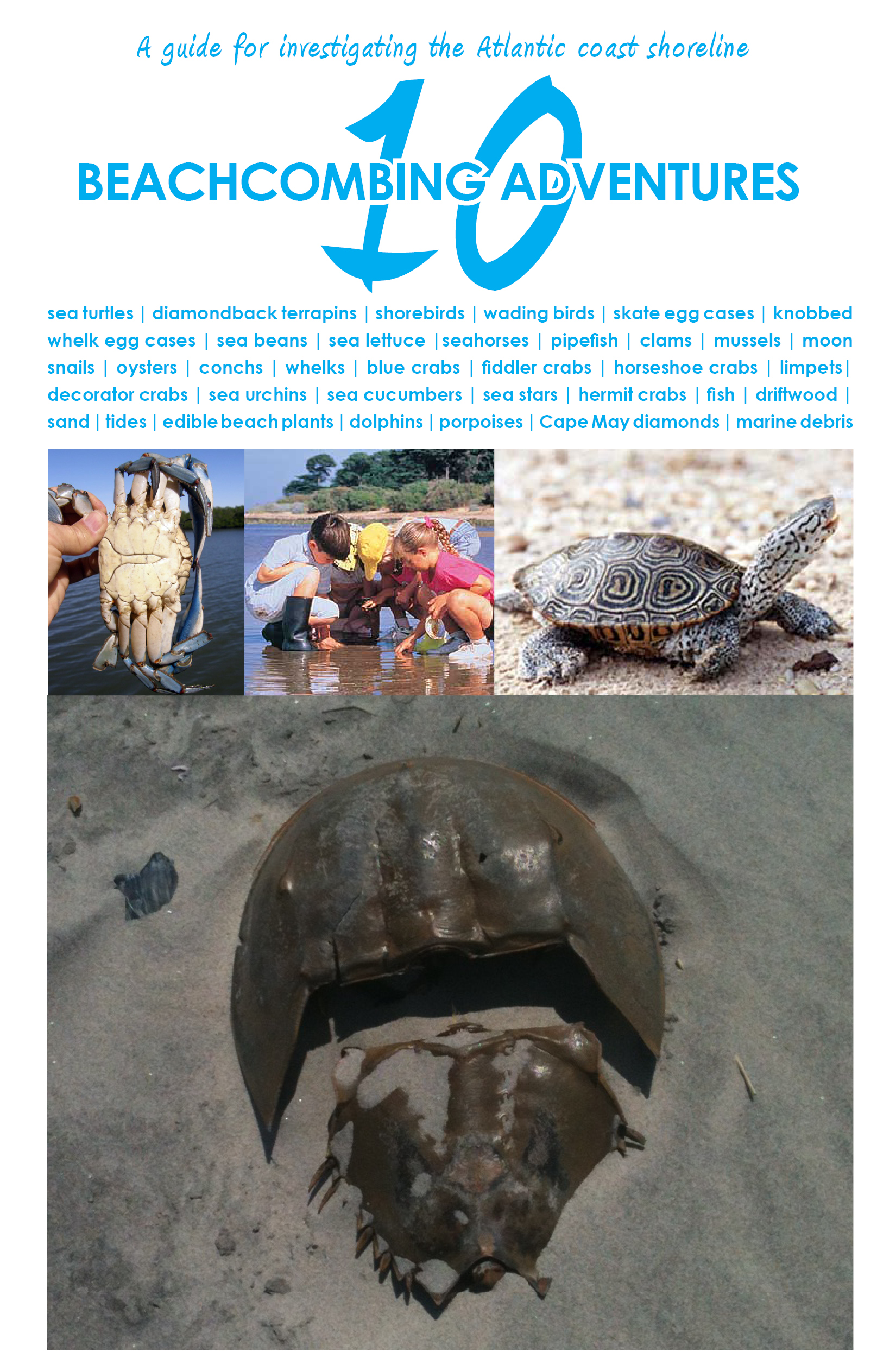
3. Play. You might not want to go home, but you also might be in the company of some people that just don’t have a very long attention span. Even more frustrating is repeating the phrase, “No, you cannot go in the water today” over and over again. Build a sandcastle. Look to the horizon for dolphins or porpoises. Make a sand angel. Look up to the sky for cloud animals. Check out my ebook for other beachcombing adventures.

Image (c) Marine Debris Tracker

2. Bag it and track it. It’s always nice to be prepared to be able to do your part. I prefer to take along a hefty canvas bag that can fit in a backpack so I can tote marine debris back to a garbage can. You might even try to acquire one of these nifty bags with holes for sand to percolate through from the Green Bag Lady. When you head back to the car you can even do some citizen science and log your marine debris on the Marine Debris Tracker.

1. Don’t expect too much. It’s important to remember to relax and respect the area you are exploring. All of the ideas above are simply suggestions and ideas to ensure you get the most out of  a beachcombing adventure. Please don’t hesitate to share your favorite stories, spots, and other ideas for a great day. You can comment below of email me at info@beachchairscientist.com.

No balloons at the celebration for the Beach Chair Scientist …

Today is the fourth birthday of the Beach Chair Scientist blog. Despite the fact that some companies label latex balloons as ‘biodegradable’ and therefore, ‘safe’ for the environment, I will not be decorating any birthday celebration with balloons. Balloons blow! What has been widely spread is that latex balloons breakdown at ‘the same rate as an oak leaf from a tree‘. First, let me explain ‘latex’. Latex is a white tree sap of rubber particles from the plant, Hevae brasiliensis. After it is processed it becomes rubber. Rubber, as we know, is used in a variety of products because of its strong resilience and tear resistance. Balloons are made from latex (essentially, liquid rubber) once colors are added.

It just would not feel like a celebration for Beach Chair Scientist because I have been to countless beach clean-ups and see those latex and mylar balloons, as well as the strings that are tied to them, along the shoreline. Balloons are just not following the path that balloon manufacturers want us to believe. It may be true that research done in a controlled setting proves that when latex balloons rises to almost 30,000 feet they will freeze and bust into tiny slivers that fall back to earth. However, there are just too many natural factors (e.g., trees, wind) that impede balloons from rising to that height prior to losing their helium and flaying to the earth whole. Not to mention that even if latex balloons do break apart into tiny shards the tiny shard are still detrimental to the ocean. According to Sea Turtle Foundation, “Most balloons are made from ‘biodegradable’ latex, which degrades on exposure to air. However degradation can take up to six months and balloons floating in seawater can take up to twelve months to degrade”. In many areas it is illegal for mass balloon releases. Please check out your area for the local laws on balloons.

Here are ten examples of balloons affecting the ocean ecosystem:  

  1. On a New Jersey beach a sperm whale was found dying because it had a balloon in its stomach halting the passage of food.
  2. At a clean-up was on an island 5 miles out to sea – the distance cleaned at the 4 sites we targeted was about 1/2 mile of shoreline – in southern Maine this past June over 550 pounds of marine debris were found, including 232 pieces of debris (9 of which were balloons and one was found right next to a gull’s nest).
  3. Birds will collect plastic debris for their nests, and unknowingly construct death traps for their young.
  4. Balloons, plastic straws, plastic bottles, plastic bags, and metal beverage cans were found to be the most abundant type of marine debris litter as a 10-year national survey completed in 2008.
  5. Most of the trash found along the California coast during a 2003-2010 survey was 82% land-based plastics, including plastic bags, plastic bottles, balloons and straws.
  6. Fishing gear fragments, packaging materials, balloons, bottle caps, and straws were found to be the most common items found during a Cape Cod survey that collected 5,829 items along one-kilometer.
  7. A leatherback turtle starved to death because a latex balloon was stuck in its stomach. After the turtle necropsy, the only thing found in its intestines was three feet of nylon string attached to a balloon.
  8. Animals can become entangled in balloon ribbons and string, restricting their movement and their ability to feed.
  9. Bottlenose dolphins in California, loggerhead turtles in Texas, and a green turtle in Florida were all found dead after ingesting latex balloons.
  10. In the UK, Risso’s dolphins in French waters and fulmars in the North Sea are known to ingest balloons.

If you’re still keen on celebrating with balloons try to do activities where you can control them and not have them released into the atmosphere. You can put prizes inside them or decorate them or play games. Below are are alternatives for decorating and commemorating without balloons. Check out the background image from Orlando Sentinel with the juvenile loggerhead turtle swimming close to the floating balloons.

One last thing, if you’re in the DC area Saturday, July 21st and would like to join me during a stream clean-up with United By Blue please feel free to come along! It’s a great event co-sponsored by Subaru and fun for the whole family. Read this article about my first experience volunteering with them. Please feel free to drop me a line at info@beachchairscientist.com or leave a comment below if you have anything else you like to add to this post or just a question in general.

A naturalist’s must-see destination: Chincoteague National Wildlife Refuge

I have it on my bucket list to explore at least ten more National Parks in the next decade, but I am going to have to rely on family and friends to share their adventures since I just spent some time in Maine visiting Acadia National Park. My brother, wife, and their sons (8 and 6 years old) just spent a week at Chincoteague National Wildlife Refuge and have kindly taken the time to share their adventures from the boys perspective. Take a look at this 60-second  movie on what sort of wildlife awaits you at Chincoteague National Wildlife Refuge. Also, here are 5 little known facts about Chincoteague National Wildlife Refuge to hopefully entice you to visit. (The interminable forests should become graceful parks, for use and delight. — Ralph Waldo Emerson, 1844)

  1. Chincoteague National Wildlife Refuge was purchased with Duck Stamp revenues.
  2. Most historians believe that the famous Chincoteague ponies are remnants from that settlers who used the island for grazing livestock in the 1600′s in an effort to avoid difficult fencing regulation. Descendants of those ponies are still living there today.
  3. In a CNN Special from June 2012, Assateague Island National Seashore was named as one of the 7 prime spots to view wildlife. Chincoteague National Wildlife Refuge is at the Virginia end of the National Seashore.
  4. The endangered sea beach amaranth is well adapted to survive the harsh seashore conditions of Chincoteague National Wildlife Refuge.
  5. Chincoteague National Wildlife Refuge has 14 ‘pools’ that total over 2,600 acres that are carefully manipulated to control moisture levels.

What’s your favorite marine mascot?

We took our daughter to her first major league baseball game this weekend. I will never forget her cheery face when she’d point at the bright orange and black cartoon Orioles on fan’s shirts and say, “buuurrd?” The Phillies lost so it wasn’t the best experience we could have hoped for at Camden Yards, but overall my little family had an enjoyable time (also, impressive despite the 90 degree weather).

Needless to say, the day got me thinking about marine-themed mascots for major league sports in the U.S. This is a list of 9 marine mascots that might inspire your little marine biologists to follow baseball, hockey, or football or conversely that could get your little sports fan into science. I suppose if you’re a teacher, these mascots are also useful teaching tools to introduce different biological units (Ok, I am not certain what lesson you’d ever need Raymond the Seadog to introduce).

  1. T.D. the Dolphin (Miami Dolphins – NFL)
  2. Blitz the Seahawk (Seattle Seahawks – NFL)
  3. Lou Seal (San Francisco Giants – MLB)
  4. Iceburgh the Penguin (Pittsburgh Penguins – NHL)
  5. Fin the Whale (Vancouver Canucks – NHL)
  6. Raymond the Seadog (Tampa Bay Rays – MLB)
  7. Billy the Marlin (Miami Marlins – MLB)
  8. S.J. Sharkie (San Jose Sharks – NHL)
  9. Al the Octopus (Detroit Redwings – NHL)

From what I uncovered, the national basketball association is void of ocean animals as mascots. Please feel free to comment if you can think of another or just let me know if you have a favorite. Lastly, does anyone know where the Phillie Phanatic is originally from?

Comparing seabirds, shorebirds, and wading birds

Here is a general overview of 10 characteristics of seabirds (birds that spend most of their life out at sea), shorebirds (migratory birds that scurry along the shore looking for food), and wading birds (taller birds that wade in wetlands for their food).

10 characteristics of seabirds (Examples include albatross, auk, booby, frigatebird, fulmar, gannet, murre, penguin, petrel, puffin, shearwater, and tropicbirds)

1. Seabirds are pelagic, spending most of their lives far out at sea.
2. Seabirds move toward to coastal areas to breed or raise young for a minimal amount of time.
3. Seabirds are light on their undersides and dark on top (an adaptation known as countershading).
4. Seabirds have more feathers than other types of birds for more insulation and waterproofing.
5. Seabirds have flexible webbed feet to help gain traction as they take off for flight from the sea.
6. Some seabirds have unusually sharp claws used to help grasp fish under the water.
7. Some larger seabirds (e.g., albatross) have long, slim wings allowing them to soar for long distances without getting tired.
8. Some smaller seabirds have short wings for maneuvering at the surface of the water.
9. Seabirds have specialized glands to be able to drink the saltwater and excrete salts.
10. Some seabirds (e.g., gannets) have head shape is usually tapered more efficiency in plunge diving.

10 characteristics of shorebirds (Examples include avocets, black skimmer, oystercatchers, plover, sandpiper, and stilt)

1. Shorebirds have long legs, pointed beaks, and long pointed wings.
2. Most shorebirds are migratory (Impressively some shorebirds fly non-stop for 3-4 days, equivalent to a human running continuous 4-minute miles for 60 hours).
3. Shorebirds wade close to the shore and poke their bills into the ground in search of food.
4. Shorebirds are small to medium size wading birds.
5. Shorebirds tend to frequent wetlands and marshes and are biological indicators of these environmentally sensitive lands.
6. Shore birds are of the order Charadriiformes.
7. Shorebirds are very well camouflaged for their environment and their appearance may vary from place to place as plumage (feather colors) are gained or lost during breeding.
8. Shorebirds typically range in size from 0.06 to 4.4 pounds.
9. Oystercatchers have a unique triangular bill that is a cross between a knife and a chisel.
10. The black skimmer is the only native bird in North America with its lower mandible larger than the upper mandible, which helps the bird gather fish as it skims the ocean surface.

10 characteristics of wading birds (Examples include crane, egret, flamingo, herons, ibis, rail, spoonbill, and stork)

1. Wading birds are found in freshwater or saltwater on every continent except Antarctica.
2. Wading birds have long, skinny legs and toes which help them keep their balance in wet areas where water currents may be present or muddy ground is unstable. Also, longer legs make it easier for them to search for food (forage) in deeper waters.
3. Wading birds have long bills with pointed or rounded tips (depending on what is more efficient for the types of food the bird consumes).
4. Wading birds have long, flexible necks that can change shape drastically in seconds, an adaptation for proficient hunting.
5. Herons have sophisticated and beautiful plumes during the breeding season, while smaller waders such as rails are much more camouflaged.
6. Wading birds may stand motionless for long periods of time waiting for prey to come within reach.
7. When moving, their steps may be slow and deliberate to not scare prey, and freeze postures are common when these birds feel threatened.
8. Adult wading birds are quiet as an essential tool for hunting. Wading birds may be vocal while nestling or while in flocks together.
9. Many wading birds form communal roosts and breeding rookeries, even mixing flocks of different species of wading birds or waterfowl.
10. Wading birds fully extend their legs to the rear when flying. The neck may be extended or not while in flight, depending on the species.

An important call for more forage fish to remain in the sea

A report titled “Little Fish Big Impact”, written by the Lenfest Forage Fish Task Force, came out earlier this month recommending that the amount of forage fish (e.g., menhaden, herring, shad) that we take from the ocean should be cut in half. However, since forage fish have an annual value world-wide of $5.6 billion dollars and are almost 40% of the world’s commercial fish catch these suggestions might be a tough sell to get passed through many decisions makers. But, here is why it is important we do.

You may not typically think of forage fish, also know as ‘bait fish’, as being a high commodity for fishermen or as playing an imperative role in the ocean – but, they do indeed! It’s surprising how much these little fish play a role in our daily lives.

Within the marine food web we begin with the tiny microscopic phytoplankton (plants that get their energy from the sun). Phytoplankton are  then in turn grazed upon by tiny copepods and  they are then fed upon these forage fish and crustaceans that are fed on by larger fish (e.g., striped bass, bluefish) that are then fed upon by the top predators (e.g., tunas, swordfish) that then feed us. Easy, right? Well, Dr. Daniel Pauly pointed out that within fisheries what is happening today is an imbalance of ‘Fishing Down the Marine Food Web’.

Time increases toward the right along the blue arrow. Scale on the right gives the trophic level in the food web. (Pauly, 2003)

This is the concept that when top predators are removed smaller fish become more of a target. Which would mean that the average trophic level of the food web would shift (Trophic being the level an organism occupies within a food chain). Specifically, forage fish are the primary source of protein for penguins, marine mammals, cod, salmon, tuna, and even puffins. We use these species for the production of fish oil supplements, food for livestock, and food provided to the fish we’re farming via aquaculture.

The Lenfest Report provides information and recommendations to fisheries managers in a three-tiered approach that the Task Force says was lacking prior, which is why we’ve currently been able to harvest the amount of forage fish at such high levels. The three-tiered approach involves understanding the 1) dynamics of the fishery, 2)  knowledge of the status of the trends of the fishery’s predators, as well as 3) recommended management actions.

“Traditionally we have been managing fisheries for forage species in a manner that cannot sustain the food webs, or some of the industries, they support. As three-fourths of marine ecosystems in our study have predators highly dependent on forage fish, it is economically and biologically imperative that we develop smarter management for these small but significant species,” stated Dr. Ellen K. Pikitch of the Institute for Ocean Conservation Science at Stony Brook University (they led the Lenfest Forage Fish Task Force).

Most recently, managers in the Mid-Atlantic have noticed the increasing importance of forage fish and voted to reduce the annual harvest of menhaden from 183,000 metric tons to 174,000. Read more here on the report and what other measures are being done to keep menhaden levels more sustainable.

It will be interesting to see how this report impacts forage fisheries in the future. I certainly hope it does.

Check out this video from the Task Force to learn more on the importance of forage fish.

Lastly, here is a quick overview of what it means to be a sustainable fishery:

  • If we are referring to a sustainable wild fishery (one that is not farmed) it could be the measure of the abundance and resilience to fishing pressure, how well-managed the fishery is based on current research, and/or that the fishery is harvested in ways that do not harm the environment or have negative interactions with protected species as bycatch.
  • With farmed species a sustainable it is typically a measure of minimizing marine resources, preventing escapes or diseases to wild stocks, as well as ensuring that the fishery is not associated with high pollution or other ways of negatively harming the habitat.
  • For a good resource to discover what fishery is sustainable in your region,  please check out the Monterey Bay Seafood Watch.

5 fascinating facts about the woodstork

In a previous life I led birding tours for the South Florida Water Management District and was always in awe of this species.  Also known as “Wood Ibis”, “Ironhead”, or “Flinthead” the woodstork is a character all unto its own. Here are 5 fun facts about the goofy looking bird.

  1. The woodstork is the only stork native to North America.
  2. They are very colonial birds and prefer to nest in the company of other storks.
  3. Even though they might look like they would be awkward in the air they are particularly graceful in flight.
  4. The time it takes for the woodstork to grab a fish and take it in its beak once is it detected is one of the quickest in the animal kingdom.
  5. The woodstork has earned the nickname “Preacherbird” because they insist on the practice of standing around, as if contemplating life, after eating.

And, this is not necessarily a fact, but the population of the woodstock in North America is in trouble with continuous droughts in Florida. One part of the Comprehensive Everglades Restoration Project (CERP), the Stormwater Treatment Areas, are very incredibly beneficial to reinvigorating the species.

I ask you, what is more adorable: a baby woodstork or a baby giraffe?

Image (c) top – gatorland.com, bottom – blog.catandturtle.net

New ‘marine life encyclopedia’ launched

I think there might be another great bookmark to add to your ocean facts files! Please spend some time reviewing this great new resource, a marine life encyclopedia, compiled by Oceana. Over 500 creatures, places, and concepts can be explored. The pictures are bright and colorful and the information is up-to-date and easy to digest. It seems fantastic if you want a quick answer to a question.

Even if you think you know all the answers, test yourself with this Ocean IQ quiz!

The content on the marine life encyclopedia site has been licensed to Dorling Kindersley, one of the world’s leading educational publishers.

Top 5 beachcomber questions answered

Sea urchin

Image via Wikipedia

Take a look at this quarter’s top 5 reasons folks end up on our site. (Due to the amazing power of WordPress I can see what you’re typing into a search that would lead you here!)

1. How do fish give birth?

2. How do flamingos get their color?

3. What is the biggest fish in the sea?

4. What eats sea urchins?

5. Do sharks have bones?

Anytime you have a beachcombing or ocean related question feel free to email us at info@beachchairscientist.com.