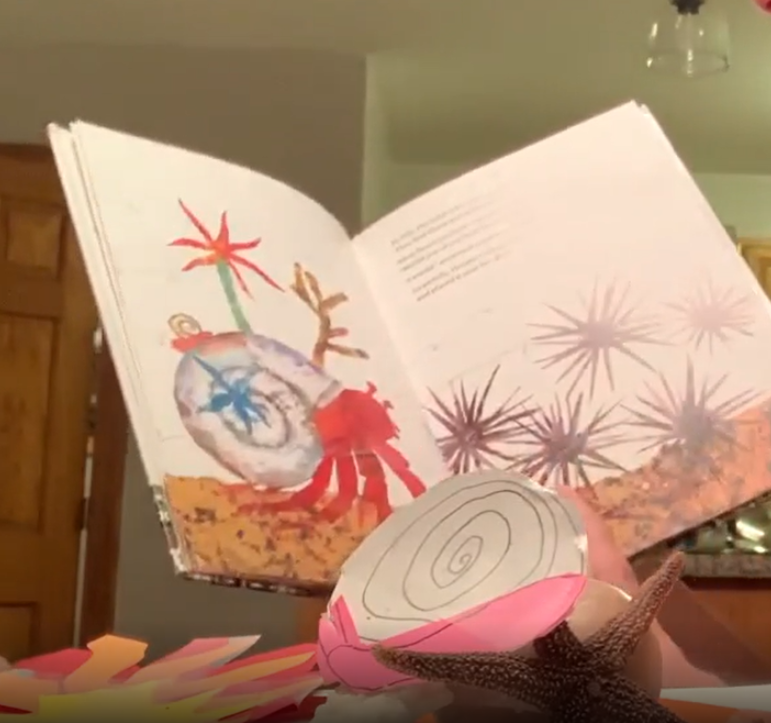
What makes your home “special”? Check out this story about a hermit crab making the most of their home “A House for Hermit Crab” by Eric Carle and enacted with colorful crafts made by Shepherd.
Marine & Freshwater Environmental Education
What makes your home “special”? Check out this story about a hermit crab making the most of their home “A House for Hermit Crab” by Eric Carle and enacted with colorful crafts made by Shepherd.
This site uses Akismet to reduce spam. Learn how your comment data is processed.
I won’t say it has anything to do with us … oh, wait … yes, I will. The ocean is getting warmer because of climate change. One effect of this would be that many animals that pretty much only preferred the luxurious tropical waters of the south Atlantic now find the Mid-Atlantic waters great! Oh, […]
I am sure you know by now, but this is a series I have been featuring each Tuesday this summer to get a special sneak peek at the different personalities behind the scientists, activists, and educators (including bloggers) who play an integral role in the marine science conservation field. It’s essentially an extension of the […]
http://www.istitutotethys.org/gargano/ They suspect a high ingestion rate of plastic bags. Do you have a question for the Beach Chair Scientist? E-mail info@beachchairscientist.com
In 1991 the Environmental Protection Agency (EPA) declared May to be National Wetlands Month. They set aside the day to celebrate the economic and ecological value of wetlands and educate America of the natural resource. Throughout the country events take place to encourage you to learn more about wetlands and take action to restore them. […]
That’s right! American lobsters can be blue (rather than the brownish/green color they typically are prior to cooking) due to either a genetic modification or an abnormal diet. Both colored lobsters taste the same. One in every two million lobsters can be blue. Enjoy this funny video from the folks at CapeCast.
What I think you are referring to is the trail of a moon snail, or sometimes called a sand snail. This univalve animal has a cinnamon bun swirled shell. The shell is extremely thick to protect itself from the ocean and other animals that may try to eat it. If you try to pick it […]
The answer is “very carefully”. Female terrapins need to look for a spot above the high tide line to lay a nest for their eggs (They lay on average 2 clutches of approximately a dozen eggs each summer). The challenge is getting to a spot on the beach above the high tide line (dunes are […]
“It is the supreme art of the teacher to awaken joy in creative expression and knowledge”. Albert Einstein (1879 – 1955) German-Swiss-U.S. scientist “The scientist is not a person who gives the right answers, he’s one who asks the right questions”. Claude Levi-Strauss (1908 – 2009) French anthropologist and ethnologist “Those that can’t do, teach”. […]
Sand from islands or tropical sites have sand that is high in Calcium, since seashells are rich in Calcium and are broken down to form sand there. Inland lake, river, stream and pond sands are high in Silicon, since rocks are composed of various types of silicates which break down to form sand there. Most […]
Upwelling is the phenomenon of wind moving surface waters thus to make way for cold, dense water that comes from the bottom of the ocean. It seems to most often happen on the west coast of continents. That is why you typically need a nice wet suit all year round to go surfing in California.




Copyright © 2026 · Free Wordpress Install by FreemiumPress.com
Speak Your Mind