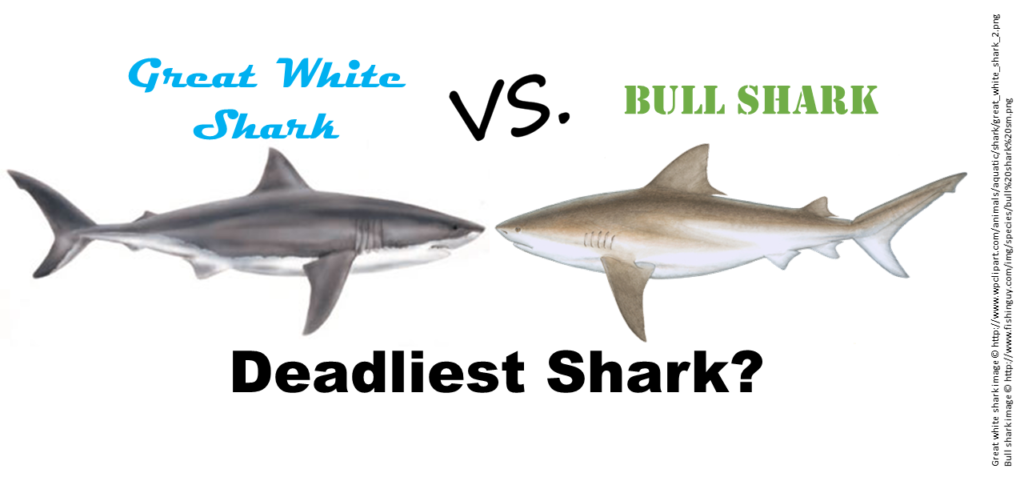
GREAT WHITE SHARK: Most great white sharks average in at about 15 feet in length, but some have been recorded as long as 20 feet. That’s a huge fish! They can reach speeds of 15 miles per hour (mph). So, the great white is a slow but mighty creature. Their bite force can reach up to 4,000 pounds per square inch (psi). Along with that … Great white have several rows of teeth and they are even serrated. Pretty scary mouth, if I do say so.
BULL SHARK: Bull sharks are typically eight feet in length, so already they are significantly smaller that great white sharks. Female bull sharks weigh in at about 290 pounds. A nine foot long bull shark could have bite force of upwards of 400 pounds. It doesn’t sound like much compared to the great white, but pound-for-pound a bull shark’s bite is stronger. Bull sharks can also swim inland in rivers.
MY VERDICT: To me the major concerns are keeping the great white shark’s length in mind while on the other hand taking into account that you could run into a bull shark in freshwater. Add in that scientists have proved that a bull shark’s bite is indeed more deadly that a great white. Bull sharks are also a more territorial species and might even be in freshwater … so that poses even more of running into them. To me, it’s suddenly a no-brainier. Bull sharks are definitely the most deadly species to humans (although, we are never actually what they hunt).
This post was written by Abby Kersh. Abby is a senior at Stonewall Jackson High School. She has been fascinated by the ocean since she could walk. She plans to study marine biology in college. She would like to concentrate of shark behavior when she completes college.








Speak Your Mind