• Home
  • About BCS
  • Guest Posting on BCS
  • BCS Community Programs
  • Resources & More
  • On-the-go Exploring Pouch
  • August 1, 2026

Beach Chair Scientist

Marine & Freshwater Environmental Education

  • 10 Beachcombing Adventures
  • What Marine Conservationists Are Into …
  • Limulus Love
  • EE, Ocean, & Water Conservation Infographics
You are here: Home / Archives for grey seal

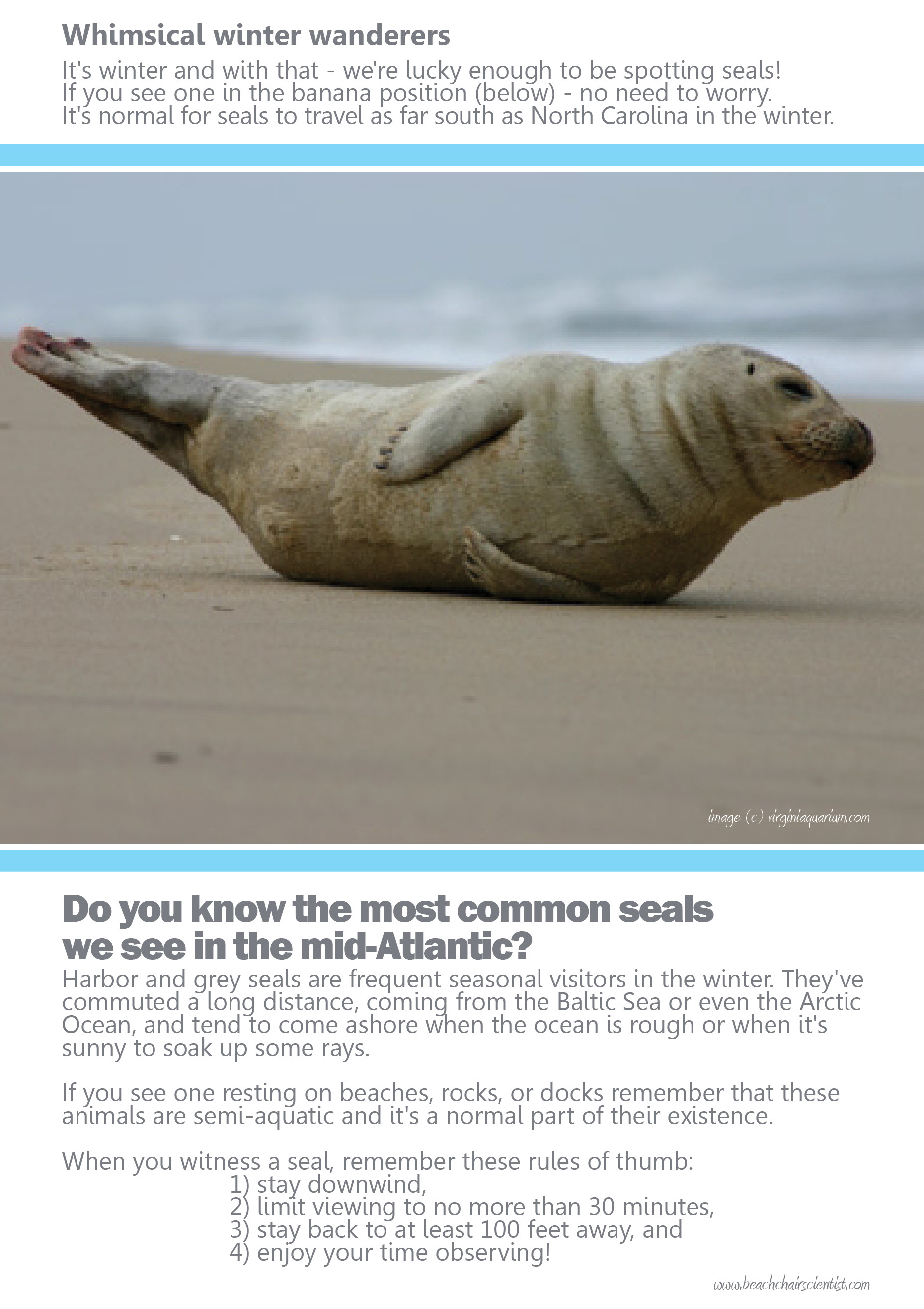
A seal on the shore isn’t always stranded

February 5, 2013 by Beach Chair Scientist Leave a Comment

BCS_Seals_large

It’s critical that you do not disturb seals when viewing. All marine mammals (e.g., seals, whales, walruses, porpoises, dolphins) are federally protected under the Marine Mammal Protection Act. If you do see an animal in distress contact your local member of the Northeast Region Marine Mammal and Sea Turtle Stranding & Entanglement Network.

Share this:

  • Click to share on Facebook (Opens in new window)
  • Click to share on Twitter (Opens in new window)
  • Click to share on Reddit (Opens in new window)
  • Click to email a link to a friend (Opens in new window)
  • Click to share on LinkedIn (Opens in new window)
Filed Under: Marine Mammals, Ocean Conservation Tagged With: grey seal, harbor seal, Marine mammal, Maryland Coastal Bays Program, MMPA, National Marine Fisheries Service, Northeast Region Marine Mammal ans Sea Turtle Stranding Entanglement Network

Connect with BCS

  • Email
  • Facebook
  • Instagram
  • Pinterest
  • RSS
  • Twitter

Follow BCS on Twitter

My Tweets

Want updates on BCS posts?

Scroll through the BCS archives …

Learn more on …

Random posts from BCS …

A naturalist’s must-see destination: Chesapeake Bay

This is a continuation on the “Where we live” series. The Chesapeake Bay has undergone similar changes to the San Francisco Bay as the population increased along its shores. As the largest estuary in North America (not the longest, which is the Indian River Lagoon in Florida), it is not surprising that the watershed of […]

Share this:

  • Click to share on Facebook (Opens in new window)
  • Click to share on Twitter (Opens in new window)
  • Click to share on Reddit (Opens in new window)
  • Click to email a link to a friend (Opens in new window)
  • Click to share on LinkedIn (Opens in new window)

How can I be a responsible fisherman?

  A lot of folks these days are interested in making certain their favorite past time of fishing is going to be around for future generations to enjoy. Here is a short list of tactics to remain ethical, while still keeping fishing that ever intense sport of glory. Best practices: – Respect the space of […]

Share this:

  • Click to share on Facebook (Opens in new window)
  • Click to share on Twitter (Opens in new window)
  • Click to share on Reddit (Opens in new window)
  • Click to email a link to a friend (Opens in new window)
  • Click to share on LinkedIn (Opens in new window)

Explore the Ocean with Google

Share this:

  • Click to share on Facebook (Opens in new window)
  • Click to share on Twitter (Opens in new window)
  • Click to share on Reddit (Opens in new window)
  • Click to email a link to a friend (Opens in new window)
  • Click to share on LinkedIn (Opens in new window)

No more fish in the sea

From Good (an on-line web magazine dedicated to enabling  individuals, businesses, and non-profits to push the world forward) an infographic detailing the decline of popular fish species in the last 50 years. The Food and Agriculture Organization of the Untied Nations calculates how many fish are left in the ocean by counting how many fish […]

Share this:

  • Click to share on Facebook (Opens in new window)
  • Click to share on Twitter (Opens in new window)
  • Click to share on Reddit (Opens in new window)
  • Click to email a link to a friend (Opens in new window)
  • Click to share on LinkedIn (Opens in new window)

Wednesday Wisdom: Anonymous

Whether it’s playing in the sea or just taking each day at a time, waves eventually bring happiness. Find more great ocean and conservation quotes here and please feel free to share with your friends and family! Also, ask away! If you have a question about something you found on the beach or just something […]

Share this:

  • Click to share on Facebook (Opens in new window)
  • Click to share on Twitter (Opens in new window)
  • Click to share on Reddit (Opens in new window)
  • Click to email a link to a friend (Opens in new window)
  • Click to share on LinkedIn (Opens in new window)

Action Project Ideas: During the Holidays (4 of 5)

One idea I had when I started this website almost ten years ago was that I wanted to make science simple and accessible. I hope I have created a place where questions on anything from barnacles to whales can be answered in a knowledgeable no-nonsense or overly jargon tone. My secondary goal has also been […]

Share this:

  • Click to share on Facebook (Opens in new window)
  • Click to share on Twitter (Opens in new window)
  • Click to share on Reddit (Opens in new window)
  • Click to email a link to a friend (Opens in new window)
  • Click to share on LinkedIn (Opens in new window)

How did fiddler crabs get their name?

The male fiddler crabs have one claw that is much larger than the other. This extra large claw is shaped like a fiddle. It is useful for two main reasons. The first being that if waved in a certain manner it attracts some hot chicks, er, female fiddler crabs. The second is that it is […]

Share this:

  • Click to share on Facebook (Opens in new window)
  • Click to share on Twitter (Opens in new window)
  • Click to share on Reddit (Opens in new window)
  • Click to email a link to a friend (Opens in new window)
  • Click to share on LinkedIn (Opens in new window)

Why does a sea urchin attach seashells to itself?

You may not notice it, but sea urchins have very thin tube-like suction cup feet, just like their close relative the sea stars. These feet are useful to grasp onto pieces of seashells, pebbles, or seaweed to disguise the sea urchin from other nearby predators. Click on this post to see what eats a sea […]

Share this:

  • Click to share on Facebook (Opens in new window)
  • Click to share on Twitter (Opens in new window)
  • Click to share on Reddit (Opens in new window)
  • Click to email a link to a friend (Opens in new window)
  • Click to share on LinkedIn (Opens in new window)

Getting to know three … Bivalve edition

Ever know instinctively that some animals are ‘related’ and just can’t pinpoint their similarities? On the third day of every month I explain three features that are common among three animals of a certain group. Of course, generally each group has more than three representatives and even  many more similarities and then even more differences, […]

Share this:

  • Click to share on Facebook (Opens in new window)
  • Click to share on Twitter (Opens in new window)
  • Click to share on Reddit (Opens in new window)
  • Click to email a link to a friend (Opens in new window)
  • Click to share on LinkedIn (Opens in new window)

What about blob(fish)?

“The blobfish is the ugliest animal in the ocean” or at least that is the consensus on many blogs and websites. I am curious if you have another ‘ugly’ favorite. Please share below and in the meantime here are five fun facts about the fish that will never win a beauty contest. But, please remember […]

Share this:

  • Click to share on Facebook (Opens in new window)
  • Click to share on Twitter (Opens in new window)
  • Click to share on Reddit (Opens in new window)
  • Click to email a link to a friend (Opens in new window)
  • Click to share on LinkedIn (Opens in new window)

Resources & more …

Flickr photos …

More Photos
UK Meds

What people are saying …

  • Robert Emahiser on Why you should never walk on dunes
  • Lesa on 10 brief facts on bioluminescence
  • Lisa on Limulus Love
  • Beach Chair Scientist on 17 facts about the wee sea potatoes
  • Bernard Rejterada on 17 facts about the wee sea potatoes
  • Brian on What is the difference between a summer and winter flounder?
  • Inbound marketing on 15 facts about the Portuguese man-of-war that’ll have you saying “Didya know…?”
  • Donnie Huckabee on Wordless Wednesday | Shell art
  • John on Why you should never walk on dunes
  • ItzJaylaD on What I know about whale sharks

Top posts & pages from BCS …

  • Hurricane vs. Cyclone vs. Typhoon
  • A House for Hermit Crab
  • How to handle a horseshoe crab
  • Snot's your house
  • Wednesday Wisdom: Various quotes (Alaska scenes)
  • A naturalist's must-see destination: Fossil Hunting at Bayfront State Park in Chesapeake Beach, MD
  • Belly biology creates lasting memories
  • Five awful puns about courtship in the sea
  • Horseshoe crabs confirmed as members of arachnid family
  • Beyond the bag: Other plastics being banned

Copyright © 2026 · Free Wordpress Install by FreemiumPress.com

Return to top of page