• Home
  • About BCS
  • Guest Posting on BCS
  • BCS Community Programs
  • Resources & More
  • On-the-go Exploring Pouch
  • May 13, 2026

Beach Chair Scientist

Marine & Freshwater Environmental Education

  • 10 Beachcombing Adventures
  • What Marine Conservationists Are Into …
  • Limulus Love
  • EE, Ocean, & Water Conservation Infographics
You are here: Home / Archives for Maryland Coastal Bays Program

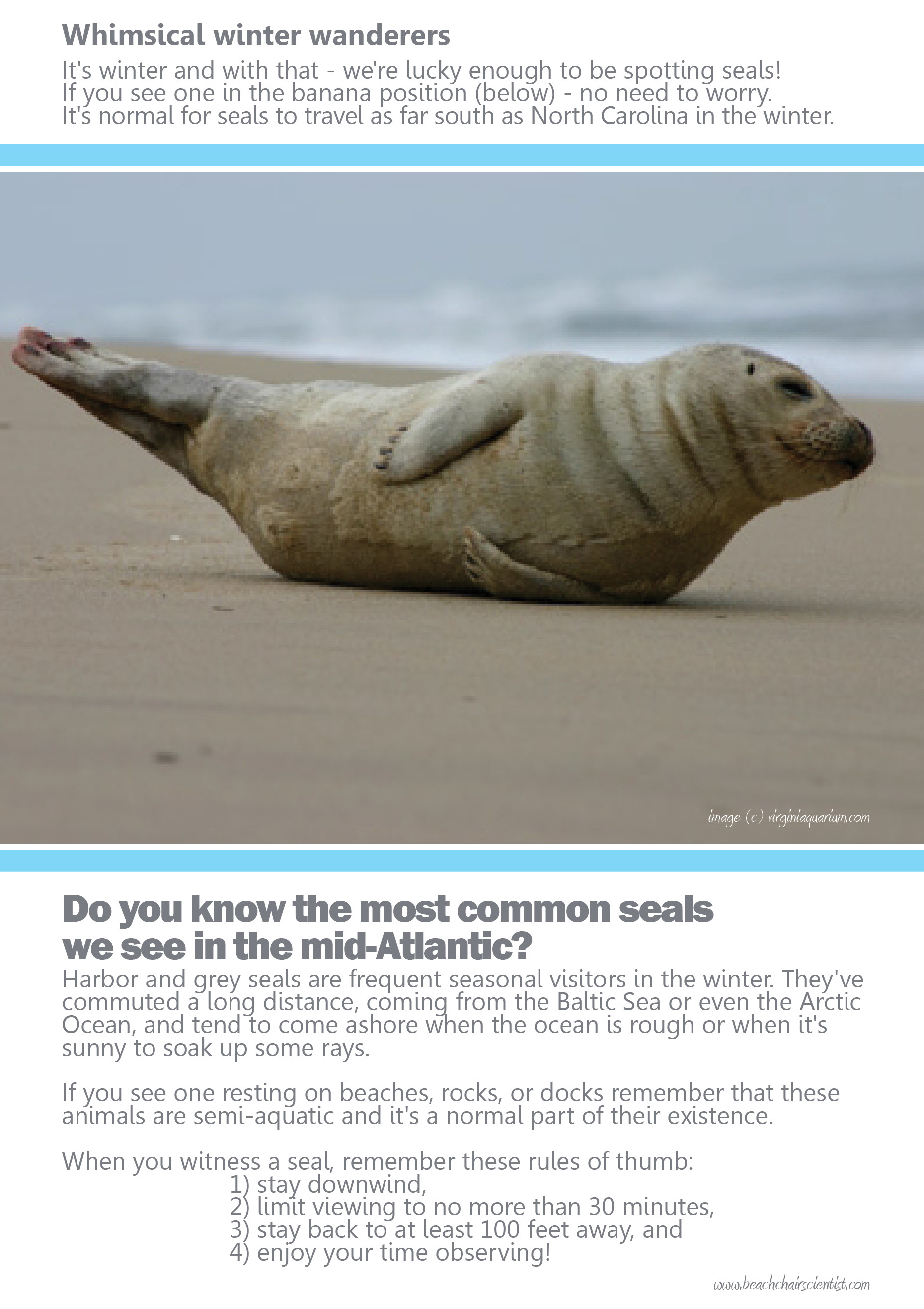
A seal on the shore isn’t always stranded

February 5, 2013 by Beach Chair Scientist Leave a Comment

BCS_Seals_large

It’s critical that you do not disturb seals when viewing. All marine mammals (e.g., seals, whales, walruses, porpoises, dolphins) are federally protected under the Marine Mammal Protection Act. If you do see an animal in distress contact your local member of the Northeast Region Marine Mammal and Sea Turtle Stranding & Entanglement Network.

Share this:

  • Click to share on Facebook (Opens in new window)
  • Click to share on Twitter (Opens in new window)
  • Click to share on Reddit (Opens in new window)
  • Click to email a link to a friend (Opens in new window)
  • Click to share on LinkedIn (Opens in new window)
Filed Under: Marine Mammals, Ocean Conservation Tagged With: grey seal, harbor seal, Marine mammal, Maryland Coastal Bays Program, MMPA, National Marine Fisheries Service, Northeast Region Marine Mammal ans Sea Turtle Stranding Entanglement Network

Connect with BCS

  • Email
  • Facebook
  • Instagram
  • Pinterest
  • RSS
  • Twitter

Follow BCS on Twitter

My Tweets

Want updates on BCS posts?

Scroll through the BCS archives …

Learn more on …

Random posts from BCS …

Reference Squid

I would love to share this wonderful squid dissection video from Paul Dewiler, Instructor of Marine Science at the San Diego Mesa College. The video was inspired by his overview during his Ultimate Squid Dissection workshop at the National Marine Educators Associations 2010 conference in Gaitlinburg, TN. He states that the purpose of the video […]

Share this:

  • Click to share on Facebook (Opens in new window)
  • Click to share on Twitter (Opens in new window)
  • Click to share on Reddit (Opens in new window)
  • Click to email a link to a friend (Opens in new window)
  • Click to share on LinkedIn (Opens in new window)

A naturalist’s must-see destination: Acadia National Park

I’ve researched some significant reasons why Acadia National Park is a popular place to go. The center of Acadia National Park is the core wintering area for purple sandpipers. Recently, a fungus lethal to bats – but harmless to humans, was found in Acadia National Park. The animals infected are said to come down with […]

Share this:

  • Click to share on Facebook (Opens in new window)
  • Click to share on Twitter (Opens in new window)
  • Click to share on Reddit (Opens in new window)
  • Click to email a link to a friend (Opens in new window)
  • Click to share on LinkedIn (Opens in new window)

Why are horseshoe crabs essential to biotechnology?

First of all, let’s chat biotechnology, or, ‘biotech’, as those in the industry call it. The concept of biotech has been around for ages, just, not given the fancy term. For instance, planting seeds to produce food, fermenting juice for wine and churning milk into cheese (that are tested with the help of mycotoxin testing […]

Share this:

  • Click to share on Facebook (Opens in new window)
  • Click to share on Twitter (Opens in new window)
  • Click to share on Reddit (Opens in new window)
  • Click to email a link to a friend (Opens in new window)
  • Click to share on LinkedIn (Opens in new window)

Test your knowledge: National Ocean Science Bowl sample question

The National Ocean Science Bowl is a high school challenge program run by the Consortium for Ocean Leadership and is dedicated to preparing the next generation of scientists, teachers, policy makers, environmental advocates and concerned citizens to “continue the exploration and develop strategies for managing the oceans’ resources.” Here is a sample question taken from […]

Share this:

  • Click to share on Facebook (Opens in new window)
  • Click to share on Twitter (Opens in new window)
  • Click to share on Reddit (Opens in new window)
  • Click to email a link to a friend (Opens in new window)
  • Click to share on LinkedIn (Opens in new window)

Jingle shells, jingle shells, jingle all the way

Oh, you know it’s stuck in your head. If not the Christmas carol, than the image of the beautiful shell that leaves a twinkle in the sand as you walk along the shoreline. Many people assume jingle shells are juvenile oysters because they’re often attached to them. But, jingle shells are their very own species […]

Share this:

  • Click to share on Facebook (Opens in new window)
  • Click to share on Twitter (Opens in new window)
  • Click to share on Reddit (Opens in new window)
  • Click to email a link to a friend (Opens in new window)
  • Click to share on LinkedIn (Opens in new window)

Don’t underestimate the utilities of algae

A reader recently asked where to find a field guide to seaweed of the northeast Atlantic and also wanted to know in particular “which species is edible, how to prepare it and what historical uses were of specific seaweeds”. I am going to do my best in answering and encourage you all to continually challenge […]

Share this:

  • Click to share on Facebook (Opens in new window)
  • Click to share on Twitter (Opens in new window)
  • Click to share on Reddit (Opens in new window)
  • Click to email a link to a friend (Opens in new window)
  • Click to share on LinkedIn (Opens in new window)

What they’re into … with Jim Wharton (Seattle Aquarium)

This is a series I’ve been featuring each Tuesday this summer to get a special sneak peek at the different personalities behind the scientists, activists, and educators (including bloggers) who play an integral role in the marine science conservation field. It’s essentially an extension of the overwhelmingly popular and well done Tumblr blog, This Is […]

Share this:

  • Click to share on Facebook (Opens in new window)
  • Click to share on Twitter (Opens in new window)
  • Click to share on Reddit (Opens in new window)
  • Click to email a link to a friend (Opens in new window)
  • Click to share on LinkedIn (Opens in new window)

What eats sea urchins?

The spines of the sea urchins are there for protection but that doesn’t stop the sea urchin from having enemies.  For instance, sea gulls love to grab them at low tide at pick away at them high upon the rocks. Crabs have a feast with the urchins by picking away at their spine to get […]

Share this:

  • Click to share on Facebook (Opens in new window)
  • Click to share on Twitter (Opens in new window)
  • Click to share on Reddit (Opens in new window)
  • Click to email a link to a friend (Opens in new window)
  • Click to share on LinkedIn (Opens in new window)

It’s as easy as A, B, Sea: T for Trilobite

Trilobites are not an opportunity to taste test three different bites of food. They are an extinct marine arthropod, that looked like a squashed centipede, dating back to the Cambrian period. They’re quite significant because paleontologists use them as an index fossil for dating back other rock structures. Image (c) smithsonianmag.com

Share this:

  • Click to share on Facebook (Opens in new window)
  • Click to share on Twitter (Opens in new window)
  • Click to share on Reddit (Opens in new window)
  • Click to email a link to a friend (Opens in new window)
  • Click to share on LinkedIn (Opens in new window)

Beach Chair Scientist’s Top Ten Posts

Now that we have posted 200 entertaining posts of random beach trivia we thought it would be fun to review the most visited posts to see what our audience enjoys reading from us. So during this holiday season let’s make a toast to the top ten most read entries. Thanks for reading all the posts […]

Share this:

  • Click to share on Facebook (Opens in new window)
  • Click to share on Twitter (Opens in new window)
  • Click to share on Reddit (Opens in new window)
  • Click to email a link to a friend (Opens in new window)
  • Click to share on LinkedIn (Opens in new window)

Resources & more …

Flickr photos …

More Photos
UK Meds

What people are saying …

  • Robert Emahiser on Why you should never walk on dunes
  • Lesa on 10 brief facts on bioluminescence
  • Lisa on Limulus Love
  • Beach Chair Scientist on 17 facts about the wee sea potatoes
  • Bernard Rejterada on 17 facts about the wee sea potatoes
  • Brian on What is the difference between a summer and winter flounder?
  • Inbound marketing on 15 facts about the Portuguese man-of-war that’ll have you saying “Didya know…?”
  • Donnie Huckabee on Wordless Wednesday | Shell art
  • John on Why you should never walk on dunes
  • ItzJaylaD on What I know about whale sharks

Top posts & pages from BCS …

  • Hurricane vs. Cyclone vs. Typhoon
  • A House for Hermit Crab
  • How to handle a horseshoe crab
  • Snot's your house
  • Wednesday Wisdom: Various quotes (Alaska scenes)
  • A naturalist's must-see destination: Fossil Hunting at Bayfront State Park in Chesapeake Beach, MD
  • Belly biology creates lasting memories
  • Five awful puns about courtship in the sea
  • Horseshoe crabs confirmed as members of arachnid family
  • Beyond the bag: Other plastics being banned

Copyright © 2026 · Free Wordpress Install by FreemiumPress.com

Return to top of page