• Home
  • About BCS
  • Guest Posting on BCS
  • BCS Community Programs
  • Resources & More
  • On-the-go Exploring Pouch
  • May 13, 2026

Beach Chair Scientist

Marine & Freshwater Environmental Education

  • 10 Beachcombing Adventures
  • What Marine Conservationists Are Into …
  • Limulus Love
  • EE, Ocean, & Water Conservation Infographics
You are here: Home / Archives for Northeast Region Marine Mammal ans Sea Turtle Stranding Entanglement Network

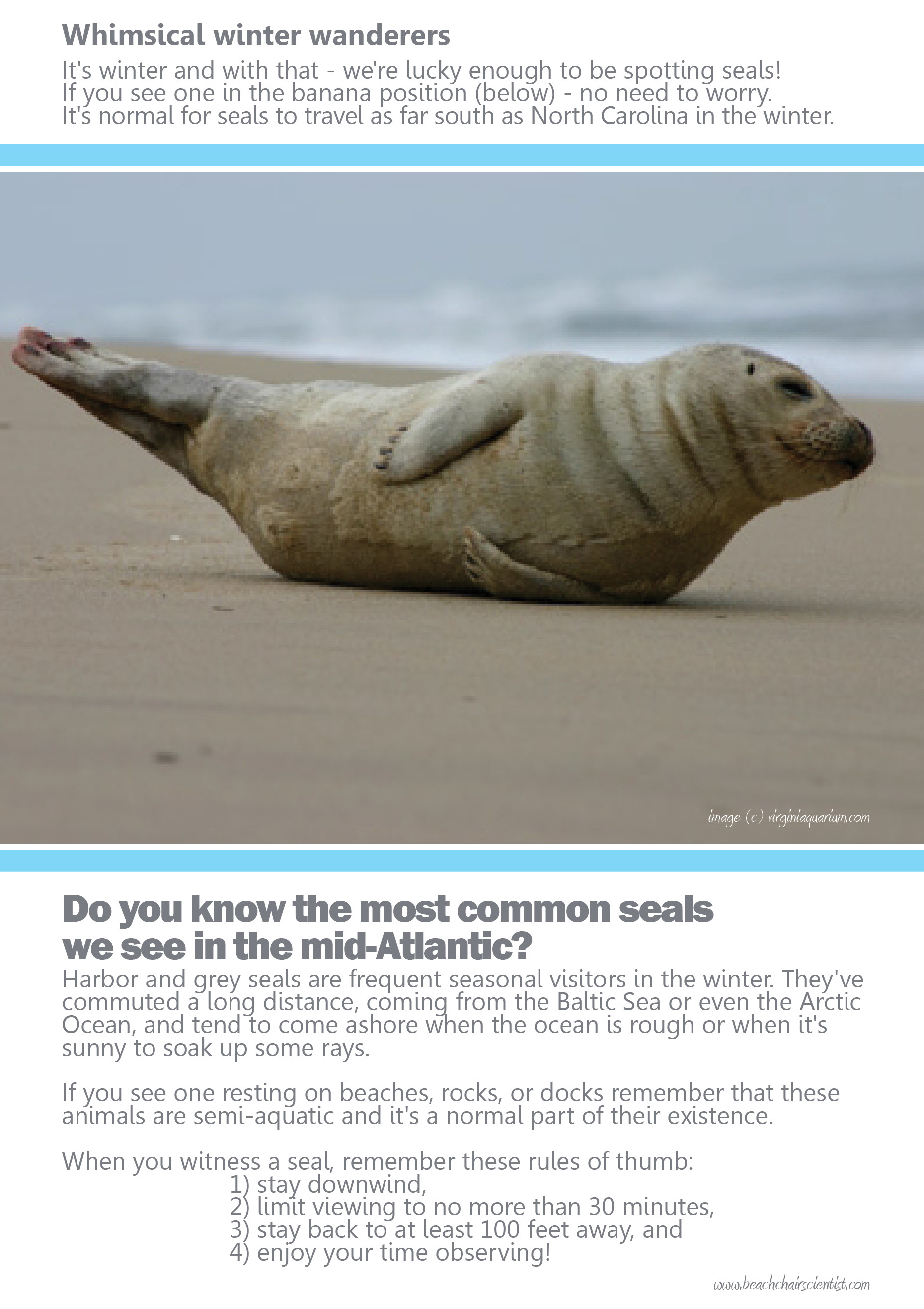
A seal on the shore isn’t always stranded

February 5, 2013 by Beach Chair Scientist Leave a Comment

BCS_Seals_large

It’s critical that you do not disturb seals when viewing. All marine mammals (e.g., seals, whales, walruses, porpoises, dolphins) are federally protected under the Marine Mammal Protection Act. If you do see an animal in distress contact your local member of the Northeast Region Marine Mammal and Sea Turtle Stranding & Entanglement Network.

Share this:

  • Click to share on Facebook (Opens in new window)
  • Click to share on Twitter (Opens in new window)
  • Click to share on Reddit (Opens in new window)
  • Click to email a link to a friend (Opens in new window)
  • Click to share on LinkedIn (Opens in new window)
Filed Under: Marine Mammals, Ocean Conservation Tagged With: grey seal, harbor seal, Marine mammal, Maryland Coastal Bays Program, MMPA, National Marine Fisheries Service, Northeast Region Marine Mammal ans Sea Turtle Stranding Entanglement Network

Connect with BCS

  • Email
  • Facebook
  • Instagram
  • Pinterest
  • RSS
  • Twitter

Follow BCS on Twitter

My Tweets

Want updates on BCS posts?

Scroll through the BCS archives …

Learn more on …

Random posts from BCS …

So you think you want to be a marine biologist?

Have you ever watched an epic movie about the sea and dreamed of being a “marine biologist” or “oceanographer”? Have you ever had thoughts after that thought about … what is the difference between a “marine biologist” and “oceanographer”? Marine biology, or the study of life in the sea, is actually just one branch of […]

Share this:

  • Click to share on Facebook (Opens in new window)
  • Click to share on Twitter (Opens in new window)
  • Click to share on Reddit (Opens in new window)
  • Click to email a link to a friend (Opens in new window)
  • Click to share on LinkedIn (Opens in new window)

Wednesday Wisdom: Gertrude Ederle

Find more great ocean and conservation quotes here and please feel free to share with your friends and family! Also, ask away! If you have a question about something you found on the beach or just something you’re curious about just send an email to info@beachchairscientist.com or tweet us!

Share this:

  • Click to share on Facebook (Opens in new window)
  • Click to share on Twitter (Opens in new window)
  • Click to share on Reddit (Opens in new window)
  • Click to email a link to a friend (Opens in new window)
  • Click to share on LinkedIn (Opens in new window)

Are we breaking up with Mother Nature?

Has it gotten to the point that when you do connect with Mother Nature it seems like an awkward hug? It’s been said time and time again that we’re better off taking a step away from technology to reconnect with Mother Nature as a regular part of our daily lives. The benefits of establishing a […]

Share this:

  • Click to share on Facebook (Opens in new window)
  • Click to share on Twitter (Opens in new window)
  • Click to share on Reddit (Opens in new window)
  • Click to email a link to a friend (Opens in new window)
  • Click to share on LinkedIn (Opens in new window)

Why are some animals ‘wallflowers’ and others are ‘social butterflies’?

An animal has many reasons to behave more like a ‘wallflower’ vs. a ‘social butterfly’. Some of the more universal reasons to lean to one behavior more than the other would be 1) habitat, 2) predators or 3) availability of food. For instance, river dolphins (pictured right) typically are solitaire animals because their habitat is […]

Share this:

  • Click to share on Facebook (Opens in new window)
  • Click to share on Twitter (Opens in new window)
  • Click to share on Reddit (Opens in new window)
  • Click to email a link to a friend (Opens in new window)
  • Click to share on LinkedIn (Opens in new window)

5 on-the-ground warriors for marine debris

I’ll be incredibly frank and honest and say that I do not do as much on-the-ground ocean activism as I’d like to do these days. I do participate the occasion stream clean-up and rally from time to time, but with a full-time job and a family including an active toddler, time is scarce and I’m […]

Share this:

  • Click to share on Facebook (Opens in new window)
  • Click to share on Twitter (Opens in new window)
  • Click to share on Reddit (Opens in new window)
  • Click to email a link to a friend (Opens in new window)
  • Click to share on LinkedIn (Opens in new window)

Hark! The herald angel (shark) strikes?

Not often. But, the angel shark has been known to strike – if provoked. These strikes are similar to those made by its cartilaginous relatives, rays and skates, coming from the surface of the ocean floor (they’re pretty good with the camouflage as you might notice from the picture on the right). However, unlike rays […]

Share this:

  • Click to share on Facebook (Opens in new window)
  • Click to share on Twitter (Opens in new window)
  • Click to share on Reddit (Opens in new window)
  • Click to email a link to a friend (Opens in new window)
  • Click to share on LinkedIn (Opens in new window)

Octopi this …

In honor of the Beatles (on today the 10th anniversary of George Harrison‘s death) I thought I would feature the incredibly intelligent animal from one of my favorite songs, Octopus’s Garden. The song (released in the US on September 1, 1969) was the second song written by Ringo Starr for The Beatles (but, as my […]

Share this:

  • Click to share on Facebook (Opens in new window)
  • Click to share on Twitter (Opens in new window)
  • Click to share on Reddit (Opens in new window)
  • Click to email a link to a friend (Opens in new window)
  • Click to share on LinkedIn (Opens in new window)

More than One Week

Tomorrow is the final day for National Environmental Education Week! It is a special week in schools because all of those children with an aptitude for understanding concepts with examples about nature have finally been able to comprehend all those complex topics they might otherwise have found overwhelming simply because the examples used in class […]

Share this:

  • Click to share on Facebook (Opens in new window)
  • Click to share on Twitter (Opens in new window)
  • Click to share on Reddit (Opens in new window)
  • Click to email a link to a friend (Opens in new window)
  • Click to share on LinkedIn (Opens in new window)

Legitimize whaling in Japan?

Yes, there has been a draft compromise made that would make it ok for whales to be taken from the oceans for “scientific research” in Japan. Read more here … http://www.panda.org/wwf_news/news/?uNewsID=189581

Share this:

  • Click to share on Facebook (Opens in new window)
  • Click to share on Twitter (Opens in new window)
  • Click to share on Reddit (Opens in new window)
  • Click to email a link to a friend (Opens in new window)
  • Click to share on LinkedIn (Opens in new window)

What do you do if you see a marine mammal stranded?

Keep calm. Also, remain at least 100 feet back so as not to scare the animal back into the ocean. If the animal is injured you want to be sure to get experts there immediately to investigate. If you are on the Atlantic coast call one of the following members of the Northeast Stranding Center. […]

Share this:

  • Click to share on Facebook (Opens in new window)
  • Click to share on Twitter (Opens in new window)
  • Click to share on Reddit (Opens in new window)
  • Click to email a link to a friend (Opens in new window)
  • Click to share on LinkedIn (Opens in new window)

Resources & more …

Flickr photos …

More Photos
UK Meds

What people are saying …

  • Robert Emahiser on Why you should never walk on dunes
  • Lesa on 10 brief facts on bioluminescence
  • Lisa on Limulus Love
  • Beach Chair Scientist on 17 facts about the wee sea potatoes
  • Bernard Rejterada on 17 facts about the wee sea potatoes
  • Brian on What is the difference between a summer and winter flounder?
  • Inbound marketing on 15 facts about the Portuguese man-of-war that’ll have you saying “Didya know…?”
  • Donnie Huckabee on Wordless Wednesday | Shell art
  • John on Why you should never walk on dunes
  • ItzJaylaD on What I know about whale sharks

Top posts & pages from BCS …

  • Hurricane vs. Cyclone vs. Typhoon
  • A House for Hermit Crab
  • How to handle a horseshoe crab
  • Snot's your house
  • Wednesday Wisdom: Various quotes (Alaska scenes)
  • A naturalist's must-see destination: Fossil Hunting at Bayfront State Park in Chesapeake Beach, MD
  • Belly biology creates lasting memories
  • Five awful puns about courtship in the sea
  • Horseshoe crabs confirmed as members of arachnid family
  • Beyond the bag: Other plastics being banned

Copyright © 2026 · Free Wordpress Install by FreemiumPress.com

Return to top of page