• Home
  • About BCS
  • Guest Posting on BCS
  • BCS Community Programs
  • Resources & More
  • On-the-go Exploring Pouch
  • October 2, 2026

Beach Chair Scientist

Marine & Freshwater Environmental Education

  • 10 Beachcombing Adventures
  • What Marine Conservationists Are Into …
  • Limulus Love
  • EE, Ocean, & Water Conservation Infographics
You are here: Home / Archives for harbor seal

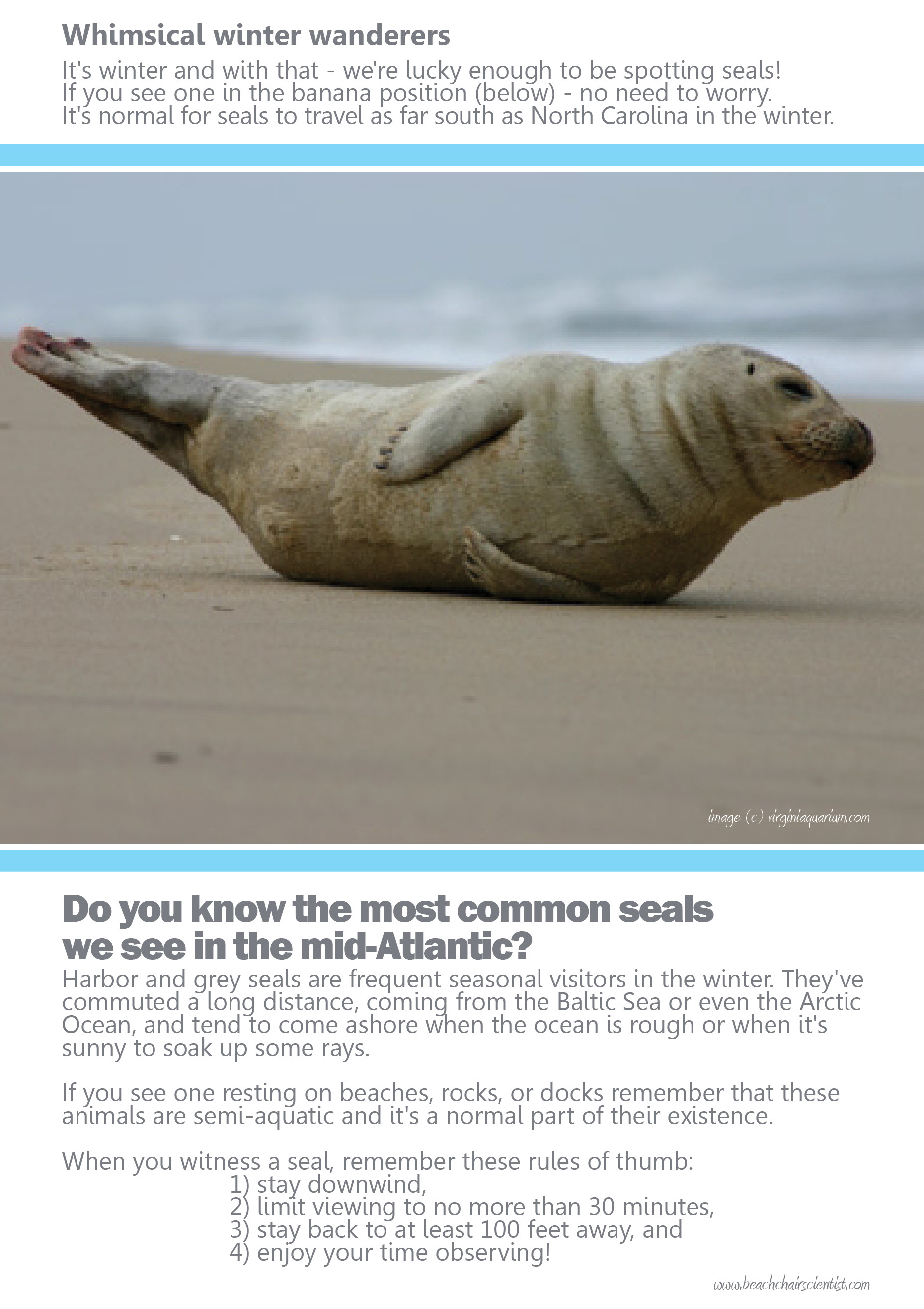
A seal on the shore isn’t always stranded

February 5, 2013 by Beach Chair Scientist Leave a Comment

BCS_Seals_large

It’s critical that you do not disturb seals when viewing. All marine mammals (e.g., seals, whales, walruses, porpoises, dolphins) are federally protected under the Marine Mammal Protection Act. If you do see an animal in distress contact your local member of the Northeast Region Marine Mammal and Sea Turtle Stranding & Entanglement Network.

Share this:

  • Click to share on Facebook (Opens in new window)
  • Click to share on Twitter (Opens in new window)
  • Click to share on Reddit (Opens in new window)
  • Click to email a link to a friend (Opens in new window)
  • Click to share on LinkedIn (Opens in new window)
Filed Under: Marine Mammals, Ocean Conservation Tagged With: grey seal, harbor seal, Marine mammal, Maryland Coastal Bays Program, MMPA, National Marine Fisheries Service, Northeast Region Marine Mammal ans Sea Turtle Stranding Entanglement Network

Connect with BCS

  • Email
  • Facebook
  • Instagram
  • Pinterest
  • RSS
  • Twitter

Follow BCS on Twitter

My Tweets

Want updates on BCS posts?

Scroll through the BCS archives …

Learn more on …

Random posts from BCS …

10 questions with a marine biologist

Here are some question and answers with Professor Jeffrey Levinton of Stony Brook University, Stony Brook, NY. He is a Distinguished Professor of Ecology and Evolution at Stony Brook University. He has been lucky to be able to teach college students for many years at the State University of New York at Stony Brook, which […]

Share this:

  • Click to share on Facebook (Opens in new window)
  • Click to share on Twitter (Opens in new window)
  • Click to share on Reddit (Opens in new window)
  • Click to email a link to a friend (Opens in new window)
  • Click to share on LinkedIn (Opens in new window)

Test your knowledge: National Ocean Science Bowl biology

Here are some more sample questions from the Consortium for Ocean Leadership‘s popular National Ocean Science Bowl (NOSB). These questions come from the Biology section. Good luck! 1) Northern elephant seals come ashore during the spring and summer to do what? a) Mate b) Eat c) Give birth d) Shed their fur 2) The habitat […]

Share this:

  • Click to share on Facebook (Opens in new window)
  • Click to share on Twitter (Opens in new window)
  • Click to share on Reddit (Opens in new window)
  • Click to email a link to a friend (Opens in new window)
  • Click to share on LinkedIn (Opens in new window)

Will I really swallow anything living if I gulp saltwater?

You just ingested a plethora of bacteria, exponentially less than that in terms of phytoplankton and then even fewer of zooplankton. Totaling several hundreds of millions of organisms – yup, that were living. Gulp. You will survive though. Just don’t make a habit out of it. Also, it should be mentioned that there are a […]

Share this:

  • Click to share on Facebook (Opens in new window)
  • Click to share on Twitter (Opens in new window)
  • Click to share on Reddit (Opens in new window)
  • Click to email a link to a friend (Opens in new window)
  • Click to share on LinkedIn (Opens in new window)

Horseshoe crabs confirmed as members of arachnid family

Even though they have ten legs – not, eight – we’ve always said horseshoe crabs are members of the arachnid family. It was first theorized by E. Ray Lankester in 1881. But, until recently, it had not been proven in terms of genetics. Scientists at the University of Wisconsin-Madison studied the molecular evolutionary patterns of […]

Share this:

  • Click to share on Facebook (Opens in new window)
  • Click to share on Twitter (Opens in new window)
  • Click to share on Reddit (Opens in new window)
  • Click to email a link to a friend (Opens in new window)
  • Click to share on LinkedIn (Opens in new window)

How did the loggerhead sea turtle get its name?

The loggerhead sea turtle, Caretta caretta, was given the common name because it has such a massive head.  On this massive head is an incredibly powerful jaw that aids the turtle in consuming any type of food it can get its mouth on. This can include corals, sponges, crabs, jellies, fish, other sea turtles,  sea […]

Share this:

  • Click to share on Facebook (Opens in new window)
  • Click to share on Twitter (Opens in new window)
  • Click to share on Reddit (Opens in new window)
  • Click to email a link to a friend (Opens in new window)
  • Click to share on LinkedIn (Opens in new window)

Project AWARE

A diet rich in fruits and vegetables has been scientifically proven to provide multiple health benefits, including lowering your risk of various chronic diseases and keeping your body healthy. Making major dietary shifts, on the other hand, can be overwhelming. For starters, changing your diet drastically can be difficult; but people can start with a […]

Share this:

  • Click to share on Facebook (Opens in new window)
  • Click to share on Twitter (Opens in new window)
  • Click to share on Reddit (Opens in new window)
  • Click to email a link to a friend (Opens in new window)
  • Click to share on LinkedIn (Opens in new window)

70 Degrees West project

I’m continuing the theme of “We affect what goes in our watershed” this week (see posts on pharmaceuticals and oil) and introducing you to an adventurous and creative couple, Justin Lewis and Michelle Stauffer, working together on the 70 Degrees West project. They launched this project almost a year ago in April of 2012 and have […]

Share this:

  • Click to share on Facebook (Opens in new window)
  • Click to share on Twitter (Opens in new window)
  • Click to share on Reddit (Opens in new window)
  • Click to email a link to a friend (Opens in new window)
  • Click to share on LinkedIn (Opens in new window)

Are we breaking up with Mother Nature?

Has it gotten to the point that when you do connect with Mother Nature it seems like an awkward hug? It’s been said time and time again that we’re better off taking a step away from technology to reconnect with Mother Nature as a regular part of our daily lives. The benefits of establishing a […]

Share this:

  • Click to share on Facebook (Opens in new window)
  • Click to share on Twitter (Opens in new window)
  • Click to share on Reddit (Opens in new window)
  • Click to email a link to a friend (Opens in new window)
  • Click to share on LinkedIn (Opens in new window)

Getting to know three … Malacostracan edition

Ever know instinctively that some animals are ‘related’ and just can’t pinpoint their similarities? On the third day of every month I explain three features that are common among three animals of a certain group. Of course, generally each group has more than three representatives and even  many more similarities and then even more differences, […]

Share this:

  • Click to share on Facebook (Opens in new window)
  • Click to share on Twitter (Opens in new window)
  • Click to share on Reddit (Opens in new window)
  • Click to email a link to a friend (Opens in new window)
  • Click to share on LinkedIn (Opens in new window)

What eats sea urchins? Revisited

Back in 2008 we brought you some information on what eats sea urchins. After all, it is hard to imagine anything being able to enjoy the spiny echinoderms. Here is an interactive game (you must have Flash) produced by Stanford University that takes it one step further. Try to place which animals and/or plants are […]

Share this:

  • Click to share on Facebook (Opens in new window)
  • Click to share on Twitter (Opens in new window)
  • Click to share on Reddit (Opens in new window)
  • Click to email a link to a friend (Opens in new window)
  • Click to share on LinkedIn (Opens in new window)

Resources & more …

Flickr photos …

More Photos
UK Meds

What people are saying …

  • Robert Emahiser on Why you should never walk on dunes
  • Lesa on 10 brief facts on bioluminescence
  • Lisa on Limulus Love
  • Beach Chair Scientist on 17 facts about the wee sea potatoes
  • Bernard Rejterada on 17 facts about the wee sea potatoes
  • Brian on What is the difference between a summer and winter flounder?
  • Inbound marketing on 15 facts about the Portuguese man-of-war that’ll have you saying “Didya know…?”
  • Donnie Huckabee on Wordless Wednesday | Shell art
  • John on Why you should never walk on dunes
  • ItzJaylaD on What I know about whale sharks

Top posts & pages from BCS …

  • Hurricane vs. Cyclone vs. Typhoon
  • A House for Hermit Crab
  • How to handle a horseshoe crab
  • Snot's your house
  • Wednesday Wisdom: Various quotes (Alaska scenes)
  • A naturalist's must-see destination: Fossil Hunting at Bayfront State Park in Chesapeake Beach, MD
  • Belly biology creates lasting memories
  • Five awful puns about courtship in the sea
  • Horseshoe crabs confirmed as members of arachnid family
  • Beyond the bag: Other plastics being banned

Copyright © 2026 · Free Wordpress Install by FreemiumPress.com

Return to top of page