http://www.istitutotethys.org/gargano/
They suspect a high ingestion rate of plastic bags.
Do you have a question for the Beach Chair Scientist? E-mail info@beachchairscientist.com
Marine & Freshwater Environmental Education
http://www.istitutotethys.org/gargano/
They suspect a high ingestion rate of plastic bags.
Do you have a question for the Beach Chair Scientist? E-mail info@beachchairscientist.com
The striped bass (Morone saxatilis) is the state fish of Maryland, Rhode Island, South Carolina, and the state saltwater fish of New York and New Hampshire. The fish is commonly referred to as the rockfish. The fish supports a $6.5 billion per year industry with 60,000 jobs as a recreational game species. Read more about this in the November 22, 2009 article in the Washington Times, “Anglers serve time for black-market rockfish trade” by Jim McElhatton.

Image (c) Fish and Wildlife Service via wikimedia
If you have any questions please e-mail beachchairscientist@gmail.com or let us know at http://www.beachchairscientist.com.
Yes, it is unfortunate. Please read the article from the New Republic  “Aquacalypse Now: The End of Fish” by Daniel Pauly (pictured) to find out more.
Daniel Pauly is a professor at the Fisheries Centre of the University of British Columbia and the principal investigator of its Sea Around Us Project.
Image (c) carmelfinley.wordpress.com
Can you guess the common name designated to the animal pictured to the right?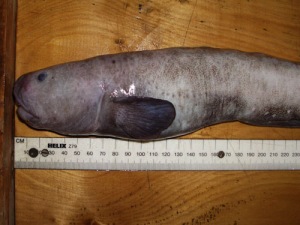
Here are some facts about the critter:
Image (c) of newscience.com

Environmental News Network sent a news release out today about a new report that states how Orca orca may die off if the numbers of king salmon continue to drop.
The research was published in the Royal Society Biology Letters. The leading cause of the death of the killer whales is actually “nutritional stress” from not being able to find the king salmon. So that is potentially what could happen to me when I do not get a happy fixing of peanut butter once in a while.
If you have any questions please e-mail beachchairscientist@gmail.com or enter it at http://www.beachchairscientist.com.
Bony fish have a swim bladder, a gas filled sac. The swim bladder originates as part of the belly. The swim bladder aids in creating an equilibrium with what is going on inside the fish and the surrounding water.
Some fish have a bladder that is part of the respiratory system, called an air bladder. It even creates a drumming sound. Croaker, red drum and black drum are part of the group.
Fish that have a skeleton made of cartilage do not have a swim bladder.
Do you have another great question? Check out www.beachchairscientist.com and enter let us know or e-mail beachchairscientist@gmail.com!
People often wear shark’s teeth around their neck. But, what is the significance and how do they get them? As the internet research states a sharks tooth symbolizes virility. I am not going to get any further into that aspect of the question. To each his or her own.
Here is some information on the rest of the question.
Shark teeth are plentiful. They may have up to 20,000 teeth in their lifetime! Once we lose our baby teeth we have only 32 adult teeth for the rest of our lives. However, sharks are constantly replacing their teeth whenever they get torn out. They may get torn out when 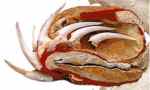 ripping apart prey. This may seem like it will hurt, but, a shark’s entire skeleton is made out of cartilage. Cartilage is the very flexible material we have in our ears and nose. The shark’s stock supply of teeth act like a conveyor belt constantly ready to replace one that has fallen out (pictured).
Here are really great places to go exploring for shark teeth: Shark River, N.J.; Flag Pond Beach, MD; Amelia Island, FL; and Cooper River, S.C.
Also, again, Happy Shark Week!
Do you have another great question? Check out www.beachchairscientist.com and enter let us know or e-mail beachchairscientist@gmail.com!
image (c) sharkfact.org
Sharks really do have a sixth sense.
It is the electrosensory organ that we spoke of with the hammerhead sharks. The electrosensory organ is called the ampullae of Lorenzini. Sounds intimidating, however, it’s really just a jelly filled canal that starts near the nose and helps them find food under the sand and figure out what direction they are going.
Do you have another great question? Email info@beachchairscientist.com.
It really feels like a phenomenon – especially when Poets.org is also celebrating Shark Week!
Here is a good one from the site by Isaac McLellan (poem “The Bluefish“):
The weaker tenants of the main
Flee from their rage in vain,
The vast menhaden multitudes
They massacre o’er the flood;
With lashing tail, with snapping teeth
They stain the tides with blood.
Do you have another great question? Check out www.beachchairscientist.com and enter let us know or e-mail beachchairscientist@gmail.com!
The hammerhead shark has evolved the interesting looking skull cap to accommodate its extra collection electrosensory organs. All sharks do have these electrosensory organs, but, the hammerhead has a bit more than the average shark species. 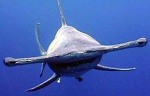 The electrosensory organ are useful for traveling far distances in the open ocean. It is like a internal GPS system. (I am not sure if it comes with a funny British accent like the one in my uncle’s car though.)
Also, another reason that the hammerhead may have evolved that shaped head is because it loves to eat squid. That head will surely be able to tangle up those tentacles lurking around the corners.
Again, Happy Shark Week!
Do you have another great question? Check out www.beachchairscientist.com and enter let us know or e-mail beachchairscientist@gmail.com!
Image (c) animalport.com






What people are saying …