• Home
  • About BCS
  • Guest Posting on BCS
  • BCS Community Programs
  • Resources & More
  • On-the-go Exploring Pouch
  • August 22, 2026

Beach Chair Scientist

Marine & Freshwater Environmental Education

  • 10 Beachcombing Adventures
  • What Marine Conservationists Are Into …
  • Limulus Love
  • EE, Ocean, & Water Conservation Infographics
You are here: Home / Archives for grey seal

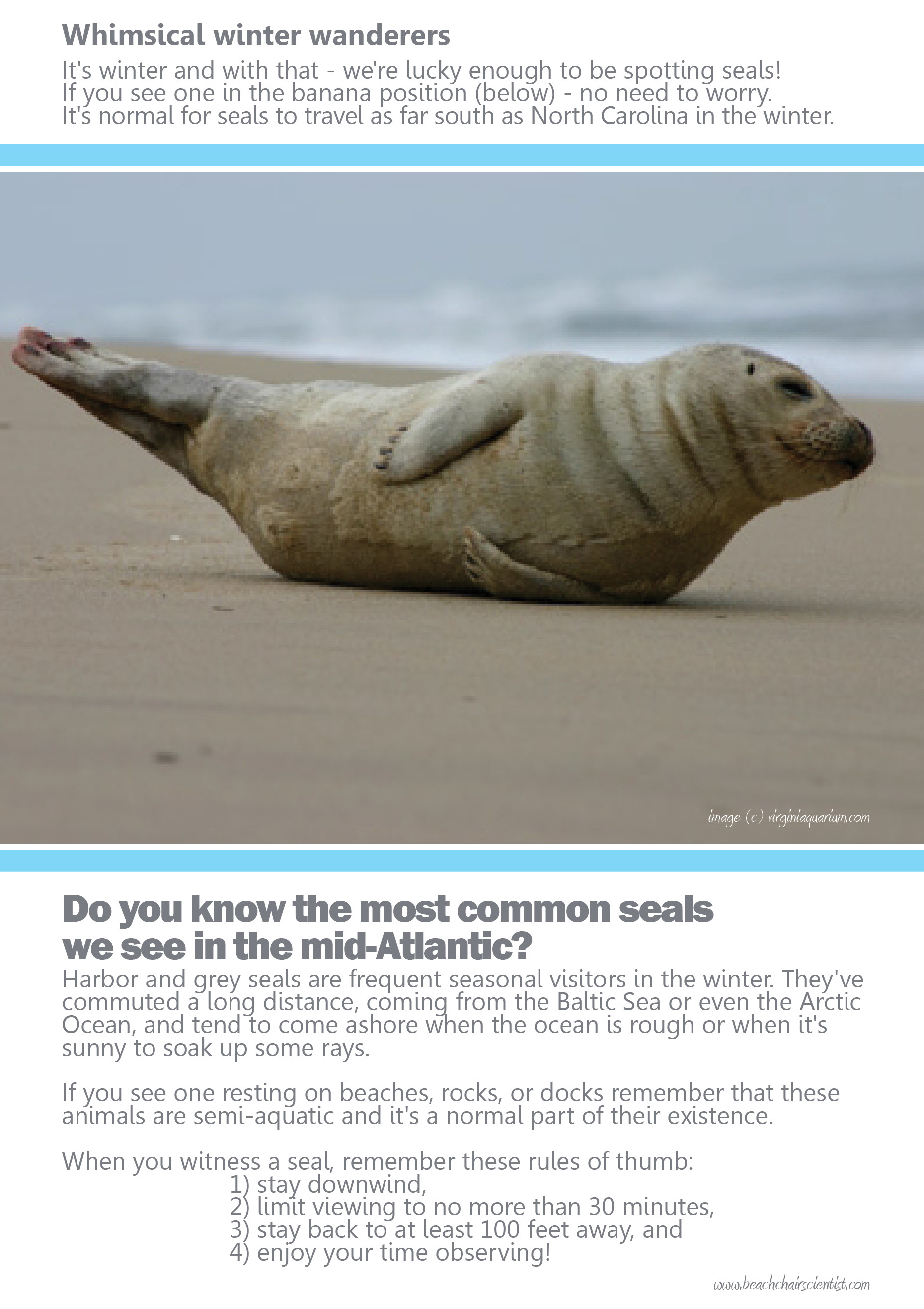
A seal on the shore isn’t always stranded

February 5, 2013 by Beach Chair Scientist Leave a Comment

BCS_Seals_large

It’s critical that you do not disturb seals when viewing. All marine mammals (e.g., seals, whales, walruses, porpoises, dolphins) are federally protected under the Marine Mammal Protection Act. If you do see an animal in distress contact your local member of the Northeast Region Marine Mammal and Sea Turtle Stranding & Entanglement Network.

Share this:

  • Click to share on Facebook (Opens in new window)
  • Click to share on Twitter (Opens in new window)
  • Click to share on Reddit (Opens in new window)
  • Click to email a link to a friend (Opens in new window)
  • Click to share on LinkedIn (Opens in new window)
Filed Under: Marine Mammals, Ocean Conservation Tagged With: grey seal, harbor seal, Marine mammal, Maryland Coastal Bays Program, MMPA, National Marine Fisheries Service, Northeast Region Marine Mammal ans Sea Turtle Stranding Entanglement Network

Connect with BCS

  • Email
  • Facebook
  • Instagram
  • Pinterest
  • RSS
  • Twitter

Follow BCS on Twitter

My Tweets

Want updates on BCS posts?

Scroll through the BCS archives …

Learn more on …

Random posts from BCS …

If you gooble, gooble the turkeyfish know your source

The extravagant fins of the lionfish, native to the Indo-Pacific, resemble the plumage of turkeys and have thus earned the additional common name of ‘turkeyfish’. What is so ironic about that particular nickname is that scientists and fisheries managers have urged us to ‘gooble’ up this exotic looking creature. What’s happened over time is a […]

Share this:

  • Click to share on Facebook (Opens in new window)
  • Click to share on Twitter (Opens in new window)
  • Click to share on Reddit (Opens in new window)
  • Click to email a link to a friend (Opens in new window)
  • Click to share on LinkedIn (Opens in new window)

10 fish you don’t see during Shark Week

I confess. I’ve given up on Shark Week. It took 25 years to shake me, but for the first time I can remember, I won’t be watching. When I was 16, you couldn’t schedule enough great white and shark attack programming to satisfy me. Danger Beach, Vic Hislop, Air Jaws … it was all good. […]

Share this:

  • Click to share on Facebook (Opens in new window)
  • Click to share on Twitter (Opens in new window)
  • Click to share on Reddit (Opens in new window)
  • Click to email a link to a friend (Opens in new window)
  • Click to share on LinkedIn (Opens in new window)

What is a Marine Protected Area (MPA)?

“A marine protected area (MPA) in the ocean is similar in concept to what a national park is on the terrestrial environment.” Shifting Baselines There are many terms that mean ‘MPA’, including: sanctuaries, parks, preserves, or natural areas. All of these areas have some boundary in the oceans and are protected by either the Department […]

Share this:

  • Click to share on Facebook (Opens in new window)
  • Click to share on Twitter (Opens in new window)
  • Click to share on Reddit (Opens in new window)
  • Click to email a link to a friend (Opens in new window)
  • Click to share on LinkedIn (Opens in new window)

Answers to “Test your knowledge of sea stars”

Answers to “Test your knowledge of sea stars” from December 31, 2009. True or False: Sea stars are fish. They are echinoderms, a group of invertebrates. Invertebrates have no backbones. All fish have backbones. True or False: Sea stars are closely related to sea cucumbers, sea urchins and brittle stars. True or False: Sea stars […]

Share this:

  • Click to share on Facebook (Opens in new window)
  • Click to share on Twitter (Opens in new window)
  • Click to share on Reddit (Opens in new window)
  • Click to email a link to a friend (Opens in new window)
  • Click to share on LinkedIn (Opens in new window)

Do all jellies sting?

Yes, they do. All jellies have specialized structures called cnidoblasts. Inside the cnidoblasts are capsules called nematocysts. Inside each nematocyst is a coiled, hollow thread. Nematocysts are triggered by mechanical (touch) or chemical stimuli. When they fire, the thread turns inside out, pierces its prey and delivers its venom. A jelly’s tentacles and oral arms […]

Share this:

  • Click to share on Facebook (Opens in new window)
  • Click to share on Twitter (Opens in new window)
  • Click to share on Reddit (Opens in new window)
  • Click to email a link to a friend (Opens in new window)
  • Click to share on LinkedIn (Opens in new window)

Where is the coral triangle?

After some research I scored a wonderful description of where the world’s most ecologically diverse  marine ecosystem lies. Spanning over six countries this 6 million kilometers squared coral triangle is significant because it is home to six of the seven species of sea turtles. This infographic, produced by World Wildlife Fund, gives a rundown of […]

Share this:

  • Click to share on Facebook (Opens in new window)
  • Click to share on Twitter (Opens in new window)
  • Click to share on Reddit (Opens in new window)
  • Click to email a link to a friend (Opens in new window)
  • Click to share on LinkedIn (Opens in new window)

Marine Mammal Monday: The Marine Mammals of Virginia

From Robert A. Blaylock of Virginia Institute of Marine Science (VIMS) (thirty years ago!) is a pretty fun guide to look through if you’re into historical documents. Yes, that would be me. It is not very up to date on endangered species listing, but was does a fantastic job setting out on its intention “To […]

Share this:

  • Click to share on Facebook (Opens in new window)
  • Click to share on Twitter (Opens in new window)
  • Click to share on Reddit (Opens in new window)
  • Click to email a link to a friend (Opens in new window)
  • Click to share on LinkedIn (Opens in new window)

Do sharks really never stop moving?

In order to breathe sharks have to keep moving. They have to engulf water to extract the oxygen in the water and then the rest of the water filters out of their gills. If the water current is very strong they can stay still. Do you have another great question? Check out www.beachchairscientist.com and enter […]

Share this:

  • Click to share on Facebook (Opens in new window)
  • Click to share on Twitter (Opens in new window)
  • Click to share on Reddit (Opens in new window)
  • Click to email a link to a friend (Opens in new window)
  • Click to share on LinkedIn (Opens in new window)

Action Project Ideas: In the Kitchen (1 of 5)

One idea I had when I started this website almost ten years ago was that I wanted to make science simple and accessible. I hope I have created a place where questions on anything from barnacles to whales can be answered in a knowledgeable no-nonsense or overly jargon tone. My secondary goal has also been […]

Share this:

  • Click to share on Facebook (Opens in new window)
  • Click to share on Twitter (Opens in new window)
  • Click to share on Reddit (Opens in new window)
  • Click to email a link to a friend (Opens in new window)
  • Click to share on LinkedIn (Opens in new window)

No, sharks do not have a sixth sense

Sharks really do have a sixth sense. It is the electrosensory organ that we spoke of with the hammerhead sharks. The electrosensory organ is called the ampullae of Lorenzini. Sounds intimidating, however, it’s really just a jelly filled canal that starts near the nose and helps them find food under the sand and figure out […]

Share this:

  • Click to share on Facebook (Opens in new window)
  • Click to share on Twitter (Opens in new window)
  • Click to share on Reddit (Opens in new window)
  • Click to email a link to a friend (Opens in new window)
  • Click to share on LinkedIn (Opens in new window)

Resources & more …

Flickr photos …

More Photos
UK Meds

What people are saying …

  • Robert Emahiser on Why you should never walk on dunes
  • Lesa on 10 brief facts on bioluminescence
  • Lisa on Limulus Love
  • Beach Chair Scientist on 17 facts about the wee sea potatoes
  • Bernard Rejterada on 17 facts about the wee sea potatoes
  • Brian on What is the difference between a summer and winter flounder?
  • Inbound marketing on 15 facts about the Portuguese man-of-war that’ll have you saying “Didya know…?”
  • Donnie Huckabee on Wordless Wednesday | Shell art
  • John on Why you should never walk on dunes
  • ItzJaylaD on What I know about whale sharks

Top posts & pages from BCS …

  • Hurricane vs. Cyclone vs. Typhoon
  • A House for Hermit Crab
  • How to handle a horseshoe crab
  • Snot's your house
  • Wednesday Wisdom: Various quotes (Alaska scenes)
  • A naturalist's must-see destination: Fossil Hunting at Bayfront State Park in Chesapeake Beach, MD
  • Belly biology creates lasting memories
  • Five awful puns about courtship in the sea
  • Horseshoe crabs confirmed as members of arachnid family
  • Beyond the bag: Other plastics being banned

Copyright © 2026 · Free Wordpress Install by FreemiumPress.com

Return to top of page