• Home
  • About BCS
  • Guest Posting on BCS
  • BCS Community Programs
  • Resources & More
  • On-the-go Exploring Pouch
  • April 23, 2026

Beach Chair Scientist

Marine & Freshwater Environmental Education

  • 10 Beachcombing Adventures
  • What Marine Conservationists Are Into …
  • Limulus Love
  • EE, Ocean, & Water Conservation Infographics
You are here: Home / Archives for harbor seal

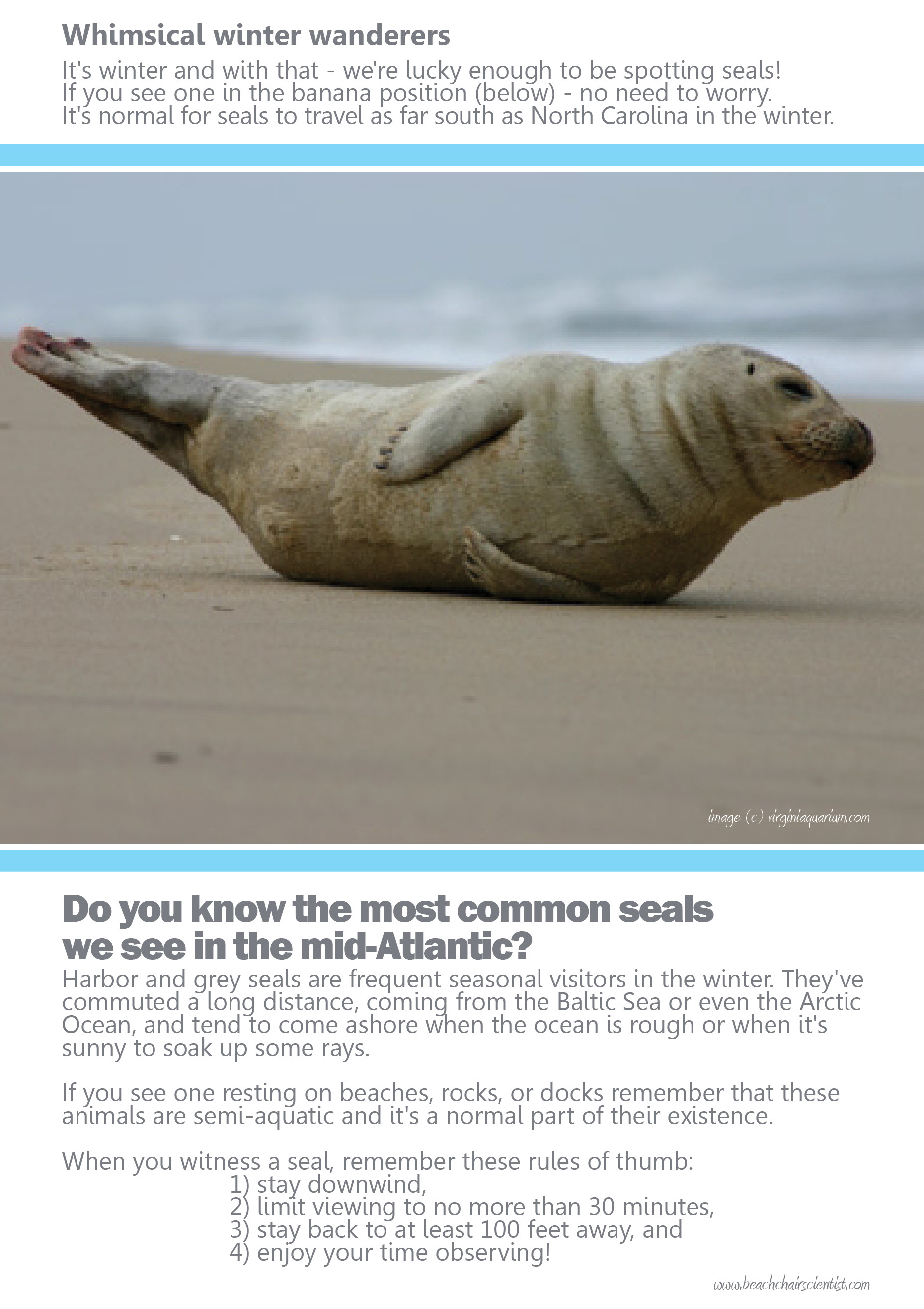
A seal on the shore isn’t always stranded

February 5, 2013 by Beach Chair Scientist Leave a Comment

BCS_Seals_large

It’s critical that you do not disturb seals when viewing. All marine mammals (e.g., seals, whales, walruses, porpoises, dolphins) are federally protected under the Marine Mammal Protection Act. If you do see an animal in distress contact your local member of the Northeast Region Marine Mammal and Sea Turtle Stranding & Entanglement Network.

Share this:

  • Click to share on Facebook (Opens in new window)
  • Click to share on Twitter (Opens in new window)
  • Click to share on Reddit (Opens in new window)
  • Click to email a link to a friend (Opens in new window)
  • Click to share on LinkedIn (Opens in new window)
Filed Under: Marine Mammals, Ocean Conservation Tagged With: grey seal, harbor seal, Marine mammal, Maryland Coastal Bays Program, MMPA, National Marine Fisheries Service, Northeast Region Marine Mammal ans Sea Turtle Stranding Entanglement Network

Connect with BCS

  • Email
  • Facebook
  • Instagram
  • Pinterest
  • RSS
  • Twitter

Follow BCS on Twitter

My Tweets

Want updates on BCS posts?

Scroll through the BCS archives …

Learn more on …

Random posts from BCS …

What are the world’s largest oceans and seas?

Great question! Here is a quick break down of the world’s largest oceans and seas using the size information found in the descriptions from The World’s Biggest Oceans & Seas by Our Amazing Planet. If you have another question please don’t hesitate to find me on Twitter using @bcsanswers or just email info@beachchairscientist.com. Have a […]

Share this:

  • Click to share on Facebook (Opens in new window)
  • Click to share on Twitter (Opens in new window)
  • Click to share on Reddit (Opens in new window)
  • Click to email a link to a friend (Opens in new window)
  • Click to share on LinkedIn (Opens in new window)

Action Project Ideas: In the Kitchen (1 of 5)

One idea I had when I started this website almost ten years ago was that I wanted to make science simple and accessible. I hope I have created a place where questions on anything from barnacles to whales can be answered in a knowledgeable no-nonsense or overly jargon tone. My secondary goal has also been […]

Share this:

  • Click to share on Facebook (Opens in new window)
  • Click to share on Twitter (Opens in new window)
  • Click to share on Reddit (Opens in new window)
  • Click to email a link to a friend (Opens in new window)
  • Click to share on LinkedIn (Opens in new window)

Why don’t fish freeze in the Arctic Ocean?

Fish species that frequent the cold temperatures of the Arctic Ocean (e.g., toothfish, cod, ice fish, etc.) have special ‘antifreeze’ proteins within their blood stream that enables them not to freeze in the cold waters of the northern hemisphere. This discovery was made about 50 years ago. Recently, scientists from the Ruhr-University Bochum in Germany […]

Share this:

  • Click to share on Facebook (Opens in new window)
  • Click to share on Twitter (Opens in new window)
  • Click to share on Reddit (Opens in new window)
  • Click to email a link to a friend (Opens in new window)
  • Click to share on LinkedIn (Opens in new window)

3 Quarks Daily science prizes awarded

Since 2009, during the  solstice and equinox of each year a prize for either science, philosophy, politics, and arts & literature is awarded by the esteemed judge brought in by the editors of the blog 3 Quarks Daily.  This filter blog, created by founding editor S. Abbas Raza, is a “one-stop intellectual surfing experience by […]

Share this:

  • Click to share on Facebook (Opens in new window)
  • Click to share on Twitter (Opens in new window)
  • Click to share on Reddit (Opens in new window)
  • Click to email a link to a friend (Opens in new window)
  • Click to share on LinkedIn (Opens in new window)

Answers to “Test your knowledge of sea stars”

Answers to “Test your knowledge of sea stars” from December 31, 2009. True or False: Sea stars are fish. They are echinoderms, a group of invertebrates. Invertebrates have no backbones. All fish have backbones. True or False: Sea stars are closely related to sea cucumbers, sea urchins and brittle stars. True or False: Sea stars […]

Share this:

  • Click to share on Facebook (Opens in new window)
  • Click to share on Twitter (Opens in new window)
  • Click to share on Reddit (Opens in new window)
  • Click to email a link to a friend (Opens in new window)
  • Click to share on LinkedIn (Opens in new window)

Beauty is in the eye of the beholder

“WhaleTimes created Hagfish Day last year to ‘celebrate the beauty of ugly.’ Hagfish are the perfect example. These deep-sea scavengers ooze slime — buckets of slime. They also play an important role in their ecosystem.” What other creatures do you think should be recognized on Hagfish Day?

Share this:

  • Click to share on Facebook (Opens in new window)
  • Click to share on Twitter (Opens in new window)
  • Click to share on Reddit (Opens in new window)
  • Click to email a link to a friend (Opens in new window)
  • Click to share on LinkedIn (Opens in new window)

What does it mean to be a barrier island?

Theoretically, a barrier island is there to protect the mainland from harsh weather. Barrier islands are a permanently exposed “mountains” from the bottom of the ocean made up of sand and rock and pebble. A lot of barrier islands are developed – as you drive to a barrier island you inevitably cross a bridge that […]

Share this:

  • Click to share on Facebook (Opens in new window)
  • Click to share on Twitter (Opens in new window)
  • Click to share on Reddit (Opens in new window)
  • Click to email a link to a friend (Opens in new window)
  • Click to share on LinkedIn (Opens in new window)

Nine signs of summer you’re still a kid at heart

Exercise and Teenagers Exercise is an important part of keeping teens healthy. Encouraging healthy lifestyles in children and teens is important for when they grow older. Lifestyles that are learned in childhood are more likely to stay with the child into adulthood. Some changes in lifestyle can be harder to make as a person ages. […]

Share this:

  • Click to share on Facebook (Opens in new window)
  • Click to share on Twitter (Opens in new window)
  • Click to share on Reddit (Opens in new window)
  • Click to email a link to a friend (Opens in new window)
  • Click to share on LinkedIn (Opens in new window)

Ho, ho, ho! Look who’s coming to town … it’s the bearded seal!

The rather short snout with thick, long, white whiskers gives this true seal it’s appropriate common name. The bearded seal (Erignathus barbatus) can be as long 8 feet and weigh up to 800 pounds. I guess now we know what idiom they use under the sea instead of “the 800 pound gorilla in the room […]

Share this:

  • Click to share on Facebook (Opens in new window)
  • Click to share on Twitter (Opens in new window)
  • Click to share on Reddit (Opens in new window)
  • Click to email a link to a friend (Opens in new window)
  • Click to share on LinkedIn (Opens in new window)

Christmas critter countdown: Star coral

Coral may look like a rock but they’re certainly not! Take some time to learn about the vulnerable species here. It’s climate change we have to worry about but the ocean habitat is up against ocean acidification and the first clue is from coral.

Share this:

  • Click to share on Facebook (Opens in new window)
  • Click to share on Twitter (Opens in new window)
  • Click to share on Reddit (Opens in new window)
  • Click to email a link to a friend (Opens in new window)
  • Click to share on LinkedIn (Opens in new window)

Resources & more …

Flickr photos …

More Photos
UK Meds

What people are saying …

  • Robert Emahiser on Why you should never walk on dunes
  • Lesa on 10 brief facts on bioluminescence
  • Lisa on Limulus Love
  • Beach Chair Scientist on 17 facts about the wee sea potatoes
  • Bernard Rejterada on 17 facts about the wee sea potatoes
  • Brian on What is the difference between a summer and winter flounder?
  • Inbound marketing on 15 facts about the Portuguese man-of-war that’ll have you saying “Didya know…?”
  • Donnie Huckabee on Wordless Wednesday | Shell art
  • John on Why you should never walk on dunes
  • ItzJaylaD on What I know about whale sharks

Top posts & pages from BCS …

  • Hurricane vs. Cyclone vs. Typhoon
  • A House for Hermit Crab
  • How to handle a horseshoe crab
  • Snot's your house
  • Wednesday Wisdom: Various quotes (Alaska scenes)
  • A naturalist's must-see destination: Fossil Hunting at Bayfront State Park in Chesapeake Beach, MD
  • Belly biology creates lasting memories
  • Five awful puns about courtship in the sea
  • Horseshoe crabs confirmed as members of arachnid family
  • Beyond the bag: Other plastics being banned

Copyright © 2026 · Free Wordpress Install by FreemiumPress.com

Return to top of page